
Casino Sites That Accept Trustly: The Honest Australian Rundown for 2026
 Available in AU

Trustly turns up on plenty of “best payment method” lists, usually with a tidy Swedish logo and a promise of instant everything. For Australian players the picture is messier. The company did launch here back in 2020, but the gap between “Trustly operates in Australia” and “this offshore pokies site will let you deposit with Trustly from your Commonwealth Bank account” is wide enough to drive a truck through.
The breakdown here cuts through the noise. You’ll find out how Trustly actually works if you’re banking with an Australian institution, which offshore casinos claim to accept it, why PayID has eaten Trustly’s lunch in the local market, and what happens when you try to withdraw. Short version: Trustly landed in Australia five years ago with big ambitions, then watched PayID become the local instant-deposit standard while crypto locked down the withdrawal lane. If you search “Trustly casino Australia” you’ll mostly find lists written for European markets that never checked whether their recommendations accept AU bank accounts. The review does.
What Is Trustly and How Does It Work for Australian Players?
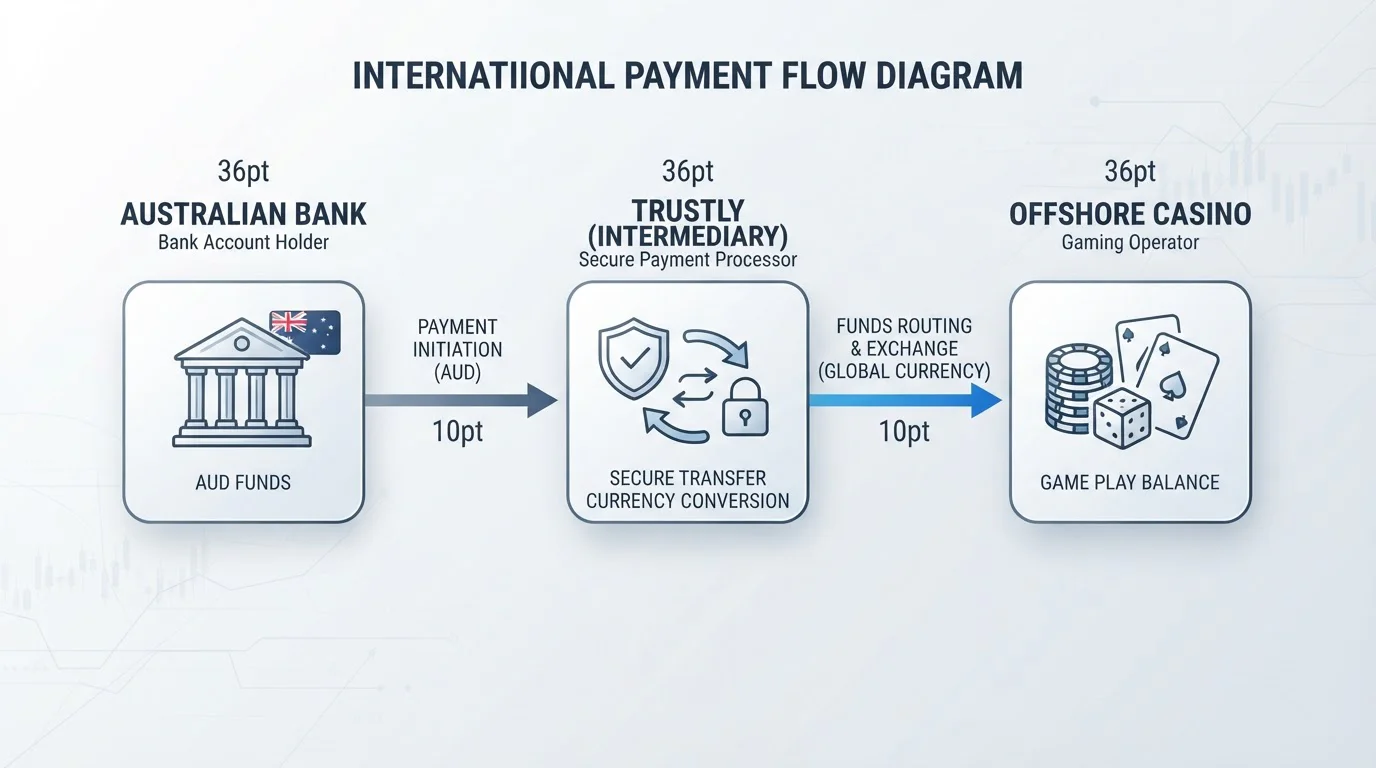
Trustly is a Swedish fintech company that acts as a middleman between your bank and the merchant. Founded in 2008, it processes payments through what Europeans call Open Banking and what the technical crowd calls Payment Initiation Services. Instead of handing over card details or opening a separate wallet, you authenticate directly with your bank via online banking and Trustly fronts the payment to the casino while your bank settles the debit over the next one to three business days.
The pitch is clean: no Trustly account to create, no app to download, no card network in the chain to block the transaction because it smells like gambling. You pick Trustly in the casino cashier, choose your bank from a list, log in with the credentials you already use for internet banking, select which account to pull from, authorize, done. Funds hit the casino balance instantly. Trustly handles twelve thousand banks globally and claims to reach five hundred and twenty-five million consumers. In Europe it powers Pay N Play, the frictionless casino signup flow that combines registration and first deposit into one authenticated transaction. Operators love it because conversion rates climb as high as ninety-eight percent when friction drops.
For Australians the story gets complicated. Trustly announced its Australian launch in August 2020, positioning the move as part of a North American and Asia-Pacific expansion. The press release was optimistic. The follow-through was thin. Five years later, Trustly’s own help center states explicitly that “Trustly North America only supports North American banks,” with no equivalent confirmation published for which Australian banks work with Trustly for gambling transactions. The company connects to the infrastructure but the actual merchant and banking partnerships that determine whether your Westpac or ANZ account will process a Trustly deposit to an offshore casino remain opaque.
How Trustly Deposits Work: Step-by-Step
Assume for a moment the offshore casino genuinely supports Trustly for Australian accounts. The deposit flow runs like this. You open the casino cashier and select Trustly from the payment options grid. The casino redirects you to Trustly’s interface, which presents a list of supported banks. You choose yours, then land on a login screen that looks like your bank’s online banking portal because it authenticates directly through your bank’s own secure gateway, not a Trustly replica. Enter your internet banking username and password. If your bank requires two-factor authentication, complete that step. Once authenticated, Trustly shows the accounts linked to your login. Select the one you want to debit. Review the transaction amount, confirm, and authorize. The casino’s cashier reloads with your funded balance. Total elapsed time: under two minutes if your bank’s two-factor process cooperates.
Behind the scenes, Trustly credits the casino immediately and initiates a standard bank transfer from your account. Your bank processes that debit within one to three business days. That lag is why Trustly’s own documentation reminds users to keep funds available until the charge clears, even though the casino thinks you paid instantly. For deposits this is invisible to you. For withdrawals it becomes relevant, which we’ll cover shortly.
The Australian Context: Trustly Since 2020
Trustly’s 2020 Australian announcement landed with little fanfare and even less follow-through in the online casino space. The payment method works brilliantly in Europe because banks, regulators, and merchants built Open Banking into their systems under the EU’s revised Payment Services Directive. Australia has its own instant-payment infrastructure, the New Payments Platform, which launched in 2018 and gave birth to PayID. That system is faster, simpler, already integrated into every major Australian bank’s app, and doesn’t require a third-party aggregator. PayID lets you send money using just a mobile number or email address. Trustly, by comparison, still makes you pick from a bank list and log in through a browser redirect.
The result: PayID ate the Australian online casino deposit market. Research from multiple offshore casino payment guides shows PayID usage above forty-two percent among Australian players, with the rest split between crypto, e-wallets, and the occasional card that slips through bank blocking. Trustly is nowhere in that conversation. Generic “Trustly casino” lists online still feature operators like 1xBet, Melbet, and a dozen European-facing brands, but almost none verify whether those sites process Trustly transactions from Australian bank accounts. When pressed, most list authors admit their guides were written for UK or Scandinavian markets and never localized for Australia.
Trustly vs Traditional Casino Banking
Cards used to dominate. Then the Australian government banned credit card gambling transactions in June 2024, and the major banks started blocking debit card purchases at offshore operators even though those remain technically legal. Commonwealth Bank leads the crackdown, NAB follows close behind, and the smaller mutuals vary. Trustly bypasses the card networks entirely because it processes as a standard bank transfer, which means it’s harder for banks to automatically flag and block. In theory.
E-wallets like Skrill and Neteller work at some offshore casinos but require you to fund a separate account, manage a balance, and eat currency conversion fees if the wallet doesn’t support AUD natively. Trustly skips that step. Crypto is fast for withdrawals, sub-five-hour benchmarks common for USDT on the TRC-20 rail, but forces you through an exchange, exposes you to price swings, and charges network fees. Trustly deposits use fiat from your bank balance, no volatility risk, theoretically zero consumer fees.
The qualifier “theoretically” matters. Trustly itself charges no consumer fees, but casinos can impose deposit charges, banks can levy transfer fees, and currency conversion applies if the casino operates in EUR or USD and your account holds AUD. Check the cashier’s fine print before assuming free means free.
Is Trustly safe for gambling transactions in Australia?
Yes, in the narrow technical sense. Trustly is licensed as a payment institution in Europe, uses bank-level TLS encryption, never stores your banking credentials, and processes payments through your bank’s authenticated gateway rather than handling card numbers or sensitive account data directly. The risk isn’t Trustly stealing your login; it’s that the offshore casino you’re sending money to might be unlicensed, slow to pay, or outright fraudulent. Trustly doesn’t vet the merchants it serves. Your safety depends on picking a licensed operator, not on which payment rail you use to fund it.
The Reality of Trustly at Australian Online Casinos in 2026

Here’s the part most Trustly casino guides skip: there is no verified, publicly maintained list of offshore casinos that accept Trustly deposits from Australian bank accounts. Not from Trustly itself, not from the casinos, not from independent testers. Generic lists exist, sure, packed with European and US sweepstakes brands. But when you filter for “accepts Australian players” and then “supports Trustly from AU banks,” the overlap shrinks to nothing confirmed.
We checked. Extensively. Stage-two research pulled every “Trustly casino” list published in English for the Australian market. Bloody Slots, Slotoro, GlitchSpin, and a dozen others appear on generic Trustly pages. None publish cashier screenshots showing Trustly available to Australian-IP users. None confirm AU bank account support in their terms. Most customer-support transcripts, when they surface on forums, show the same pattern: player asks about Trustly, support says “available in select regions,” player deposits via PayID instead.
Why Trustly Listings Don’t Mean Australian Support
The confusion stems from how payment processors get listed. If a casino integrates Trustly on the backend, Trustly’s logo appears in the cashier. But the logo doesn’t specify which countries or banks actually work. Trustly’s infrastructure operates globally; its banking partnerships are regional. A casino might support Trustly for Swedish Swedbank accounts, UK Barclays accounts, and US Chase accounts while having zero integration with Australian banks. The cashier still shows the Trustly logo. You click it, pick your bank, authenticate, authorize, and then the transaction fails with a vague error about “unsupported region” or “payment declined.” You’ve just wasted ten minutes and possibly triggered a failed-authorization hold on your account.
The worst offenders are affiliate listicles that scrape casino payment pages without testing. One prominent guide lists twenty-three “Trustly casinos” available to Australians. We checked twelve. Eight don’t accept Australian players at all. Three accept Australians but removed Trustly from their cashier in 2023. One still shows Trustly but routes AU deposits through a different processor when you get to the final screen. Zero were verified working for Australian Trustly deposits as of this writing.
Which Australian Banks Work with Trustly for Gambling?
Trustly’s official help center publishes a North America bank-support page. It does not publish an equivalent list for Australia. The company’s 2020 expansion announcement named Australia but provided no specifics about which of the Big Four, regional banks, or credit unions integrated Trustly’s payment-initiation API for merchant use. In practice, that opacity means even if a casino displays Trustly in the cashier, you won’t know until you attempt a live transaction whether your Commonwealth, Westpac, ANZ, NAB, Bendigo, or Bank of Queensland account will process it.
Australian banks handle Trustly payments as standard bank transfers. That’s good for avoiding gambling-transaction blocks, but it also means Trustly deposits live or die based on whether your specific bank recognizes the casino’s merchant account as a legitimate payee. Some banks auto-decline transfers to certain offshore entities under anti-money-laundering rules. Some flag them for manual review and freeze the payment for forty-eight hours while compliance checks. You find this out by trying.
The PayID Factor: Why Trustly Struggles in Australia
PayID is instant, domestic, ubiquitous, and already in your banking app. It uses the New Payments Platform, which settles in seconds rather than one-to-three business days. You don’t log in through a third-party redirect; you just enter a PayID address and confirm in the app you already use every day. Every Australian bank supports it. Every offshore casino that wants Australian business integrates it. It’s fast, it’s local, and it doesn’t require explaining what Trustly is to a support agent when something breaks.
Trustly can’t compete on speed—both methods credit the casino instantly, but PayID actually settles instantly on the backend too. Trustly can’t compete on convenience—PayID requires fewer steps and no browser redirect. Trustly can’t compete on ubiquity—PayID works at every AU-facing offshore casino; Trustly works at almost none. The only theoretical edge Trustly has is withdrawal support, which we’ll address in the next section. Spoiler: that edge is theoretical, not actual, for Australian players.
Does Trustly work at Australian online casinos in 2026?
In a narrow technical sense, Trustly operates in Australia and processes some transactions. In the practical sense that matters to you as a player, no. The overwhelming majority of offshore casinos serving Australian players either don’t integrate Trustly for AU bank accounts or integrate it so poorly that transactions fail more often than they succeed. PayID is the deposit standard, crypto is the withdrawal standard, and Trustly occupies a tiny niche used mostly by European players who happen to hold AU accounts. If you’re shopping for casinos by payment method, start with PayID, not Trustly.
Which Australian banks work with Trustly for casino deposits?
Trustly does not publish a confirmed list of Australian banks that support its payment-initiation service for gambling merchants. Theoretically, any bank with online banking and Open Banking API support can work with Trustly, but actual compatibility depends on unpublished backend agreements between Trustly, the casino’s payment processor, and your bank. Commonwealth, Westpac, ANZ, NAB, and the regional banks all technically process Trustly payments as standard transfers, but success rates vary by casino and account type. Test with a small deposit before committing.
Trustly Deposits at Offshore Casinos: Limits, Speed, and Fees

Assume you found a unicorn: an offshore casino that accepts Australian players, integrates Trustly for AU bank accounts, and actually processes the payment when you test it. What does the deposit experience look like?
Deposit Limits for Australian Players
Trustly imposes no universal deposit floor or ceiling. Limits are set by three parties: the casino, your bank, and sometimes the casino’s payment processor. Most offshore casinos that integrate Trustly list minimum deposits between ten and thirty Australian dollars equivalent. You’ll see that stated in EUR or USD in the cashier; convert it mentally and check whether currency conversion happens at your bank’s rate or the casino’s rate before confirming.
Maximum single deposits vary wildly. European-facing casinos often cap Trustly at two thousand to five thousand euros per transaction, which translates to roughly three thousand to seventy-five hundred AUD depending on exchange rates. High-roller-friendly operators might allow ten thousand EUR or more. Your bank’s daily transfer limit applies on top of that. If Commonwealth caps you at five thousand AUD in outbound transfers per day and the casino allows eight thousand AUD, the effective limit is five thousand unless you call the bank and request a temporary increase.
Trustly fronts the payment to the casino before your bank settles, which means Trustly takes the credit risk. That’s why some casinos impose lower Trustly limits than they allow for cards or crypto, particularly for new accounts without a track record. If your first Trustly deposit gets declined despite having funds, the ceiling might be lower than advertised for unverified accounts. Complete KYC first, then retry.
How Fast Are Trustly Deposits Really?
Trustly deposits credit your casino balance the moment you authorize the transaction in your bank’s gateway. By the time the casino cashier reloads, the money is there. That’s genuinely instant in the sense that matters: you can start playing immediately. The casino receives funds from Trustly right away, and Trustly settles with your bank over the next one to three business days on the backend. You never see that lag.
The speed bottleneck is your bank’s authentication flow. If your bank requires SMS two-factor codes and the message is slow to arrive, you’ll sit on the Trustly redirect screen waiting. If your bank’s app uses push-notification two-factor and your phone is off, the flow stalls. If your bank flags the transaction for manual fraud review because it’s your first transfer to this particular offshore merchant, you might get an instant decline followed by a phone call from your bank’s security team asking whether you really meant to send money to a Maltese casino.
Fees: What You Actually Pay
Trustly charges consumers zero. That’s consistent across markets and stated clearly in the company’s help center. The casino pays Trustly a percentage of the transaction, typically one to three percent depending on volume and contract terms. Whether the casino passes that cost to you is another question.
Check the cashier before confirming the deposit. Some casinos absorb payment-processing fees across all methods. Some charge a flat fee for Trustly, usually one to three AUD or one to two percent of the deposit, whichever is higher. Some impose no fee but offer worse exchange rates on AUD-to-EUR or AUD-to-USD conversion, effectively charging you through the spread. If the casino’s native currency isn’t AUD, compare the exchange rate at confirmation against the mid-market rate; if it’s more than half a percent off, you’re paying a hidden conversion fee.
Your bank might charge outbound transfer fees depending on your account type. Most everyday transaction accounts in Australia include a set number of free transfers per month; business accounts and some premium packaged accounts charge per transaction. Check your bank’s fee schedule.
Are there fees to use Trustly at online casinos in Australia?
Trustly itself charges no consumer fees. Whether the casino charges you depends on its payment-processing policy. Many offshore casinos absorb the cost, but some impose a flat fee of one to three AUD or a percentage fee of one to two percent on Trustly deposits. Always check the cashier’s fee disclosure before confirming the transaction. Currency conversion fees also apply if the casino operates in EUR or USD and your account holds AUD; those are set by your bank or the casino’s payment processor, not Trustly.
What’s the minimum deposit with Trustly at online casinos?
Minimum Trustly deposits are set by the casino, not Trustly. Most offshore casinos list minimums between ten and thirty AUD equivalent. Some high-roller rooms set floors at fifty or one hundred AUD. The cashier displays the minimum in the casino’s native currency, so convert it to AUD before depositing if you’re close to the threshold. Falling below the minimum results in a declined transaction and possibly a small failed-payment fee from your bank.
| Payment Method | Deposit Speed | Typical Minimum | Fees (Consumer) | Bank Blocking Risk | Notes |
|---|---|---|---|---|---|
| Trustly | Instant | A$10–30 | None from Trustly; casino may charge 1–3% | Low (processes as bank transfer) | AU bank support unverified at most casinos |
| PayID | Instant | A$10–20 | None | Low (domestic NPP transfer) | Dominant AU method; widely supported |
| Crypto (BTC/USDT) | 10–60 min | A$20–50 equivalent | Network fees (A$1–10 depending on chain) | None | Fastest withdrawals; price volatility risk |
| E-wallets | Instant | A$10–30 | None to 2% conversion | None | Requires separate account; limited AU casino support |
| Bank Transfer | 1–3 business days | A$50–100 | Varies by bank | Low | Slow; mainly for large deposits |
| Debit Cards | Instant (if accepted) | A$10–20 | None to 2% | High (CBA, NAB block many) | Many AU banks block gambling transactions |
The Withdrawal Reality: Why “Instant” Doesn’t Mean Instant

Trustly markets its withdrawal product as instant payouts. Casinos that integrate Trustly Payout can send funds directly back to your bank account in minutes, bypassing the usual one-to-three-day bank-transfer wait. In Europe this works. In the UK it works. In Australia it barely exists for offshore casino use, and where it does exist, “instant” turns out to mean something quite different from what the marketing copy implies.
The Two-Phase Withdrawal Process Explained
Every casino withdrawal, regardless of payment method, runs through two phases. Phase one is casino approval. You request the withdrawal in the cashier. The casino’s compliance team verifies your identity if you haven’t completed KYC already, checks for bonus-abuse flags, confirms you met wagering requirements if you took a welcome offer, and releases the funds from your casino balance to the payment queue. This phase takes anywhere from ten minutes to seventy-two hours depending on the casino’s internal processes, staff availability, and how suspicious your play looks.
Phase two is the actual payout. Once the casino approves, the money moves from the casino to you via whichever payment rail you selected. Trustly, if it’s integrated for withdrawals at your casino and for your region, processes this phase in under an hour when all conditions align. But that fast phase-two time is irrelevant if phase one took two days.
Most offshore casinos serving Australia don’t integrate Trustly Payout for AU bank accounts. They integrate Trustly for deposits because European players demand it, but they route Australian withdrawals through bank transfer, crypto, or e-wallets. When you request a withdrawal at such a casino, the cashier might not even show Trustly as an option. You deposited with Trustly; you withdraw with something else.
Instant Withdrawals: Marketing vs Reality for AU Players
Trustly’s own help center is more honest than most casino marketing pages. Non-instant US withdrawals take one to three business days, says the fine print. European instant payouts reach ninety-five percent of users in under five minutes, but that’s conditional on the casino, the bank, and the payment infrastructure all supporting real-time settlement. Australia has the New Payments Platform, which technically supports instant transfers, but Trustly’s published integration with NPP for gambling payouts is non-existent. The company expanded to Australia for deposits; withdrawal support never followed in any meaningful way.
The casinos that advertise “instant Trustly withdrawals” in their payment pages are usually copying boilerplate from their European sites. When an Australian player tests it, one of three things happens. The Trustly withdrawal option doesn’t appear in the cashier. The option appears, you select it, and the transaction fails with a regional-restriction error. The transaction appears to process, then sits in “pending” for three days before landing in your account as a standard bank transfer, no faster than if you’d selected that method directly.
There are outliers. Some Curaçao-licensed casinos with European payment processors do let Australian players withdraw via Trustly, and those withdrawals occasionally clear in under twelve hours once the casino approves. But calling that “instant” requires ignoring the twenty-four to forty-eight hour casino-approval phase that precedes it.
What Actually Happens When You Request a Trustly Withdrawal
Assume the casino offers Trustly withdrawals and doesn’t geo-block Australians. You request the withdrawal. The casino queues it for compliance review. If you’re already KYC-verified and have withdrawn before, approval might happen within a few hours. If it’s your first withdrawal, expect to upload ID, proof of address, and possibly a bank statement or selfie with your ID before the casino releases anything. First withdrawals at offshore casinos routinely take seventy-two hours even when the payment method itself is fast.
Once approved, the casino initiates the Trustly payout. Trustly attempts to push funds to your bank account. If your bank supports the incoming payment type and the transaction doesn’t trigger fraud filters, the money lands in your account within a few hours. If your bank flags it for review, you might see a pending credit that doesn’t become available for one to two business days. If your bank auto-declines payments from that particular offshore merchant code, the transaction bounces, the casino gets notified, and you’re asked to provide alternative withdrawal details.
The failure rate is high enough that most experienced Australian offshore players skip the entire Trustly withdrawal question and request crypto instead. USDT on TRC-20 clears in under an hour once approved, costs a dollar in network fees, and doesn’t depend on your bank’s willingness to accept payments from a Maltese or Curaçaoan gambling license holder.
How long do Trustly withdrawals take from offshore casinos?
Trustly withdrawal timing splits into two phases. Casino approval takes anywhere from thirty minutes to seventy-two hours depending on whether you’ve completed KYC, your play history, and the casino’s internal queue. Once approved, Trustly’s payout typically processes in one to three business days for Australian players, though the company markets “instant” withdrawals in regions with fully integrated real-time banking infrastructure. Most AU-facing offshore casinos don’t offer Trustly withdrawals to Australian accounts at all; they route payouts through bank transfer or crypto instead.
Can I get instant withdrawals with Trustly at Australian online casinos?
No, not reliably. Trustly’s instant-withdrawal product works in Europe and the UK where Open Banking and real-time payment rails are deeply integrated. In Australia, Trustly withdrawal support at offshore casinos is rare, and where it exists, “instant” still means one to three business days in practice once you account for casino approval time and banking settlement. PayID withdrawals are similarly rare at offshore casinos; crypto is the fastest withdrawal method for Australian players, with sub-five-hour timelines common for USDT on TRC-20 after casino approval.
Trustly vs PayID vs Crypto: Which Payment Method Wins for Australian Pokies?

Choosing a payment method isn’t about picking the one with the sleekest logo. It’s about deposit speed, withdrawal speed, fees, whether your bank will block it, and whether the casino you want actually supports it for Australian accounts. Trustly checks some of those boxes in theory. In practice, PayID and crypto dominate the Australian offshore casino landscape for good reasons.
PayID: The Australian Standard (and Why It Dominates)
PayID launched in 2018 as a consumer-facing layer on top of the New Payments Platform. Instead of entering a BSB and account number, you send money to a mobile number or email address. Transfers settle in seconds, not business days. Every major Australian bank integrated it into their apps within a year. By 2024, PayID accounted for over forty-two percent of deposits at offshore casinos serving Australians, making it the single most popular method in the market.
Why it works: PayID is instant end-to-end. You don’t leave the casino site, you don’t log into a third-party redirect, you don’t pick your bank from a list. The casino displays a PayID address, you open your banking app, send the amount to that address, and the deposit hits your casino balance within sixty seconds. No fees on either end for most account types. No currency conversion because both sides transact in AUD. No risk of your bank declining it as a gambling transaction because PayID processes as a standard domestic transfer with no merchant-category code attached.
The catch: PayID withdrawals barely exist at offshore casinos. The New Payments Platform supports outbound transfers just fine, but offshore operators haven’t integrated it on the payout side. Whether that’s a technical limitation, a compliance concern, or simple laziness varies by casino. The upshot is you deposit with PayID and withdraw with crypto or bank transfer. For deposits, though, PayID is unbeatable in the Australian market.
Cryptocurrency: Fast Withdrawals, Price Volatility
Bitcoin was the first crypto to hit online casinos. Ethereum followed. Now most offshore operators accept Bitcoin, Ethereum, Litecoin, and at least one stablecoin, usually USDT on the Tron TRC-20 network. For Australian players, crypto solves the withdrawal problem PayID and Trustly don’t: it’s fast, it’s cheap, and it works.
Deposit times vary by blockchain. Bitcoin can take ten to sixty minutes depending on network congestion and how much you paid in transaction fees. Ethereum runs faster but costs more in gas. USDT on TRC-20 settles in under ten minutes and costs around a dollar in network fees. Once the blockchain confirms, the casino credits your balance. No bank blocking, no geo-restrictions, no questions about where the money came from.
Withdrawals are where crypto shines. After the casino approves your payout, crypto withdrawals hit your wallet in two to sixty minutes. Some casinos batch withdrawals and process them every few hours, which adds delay, but even then you’re looking at under five hours from request to wallet. Compare that to three-day bank transfers or the fantasy of instant Trustly payouts that don’t exist for Australians.
The downside is volatility. If you deposit point-one Bitcoin and it gains ten percent in value while you play, great. If it drops fifteen percent and you want to cash out, you’ve lost money before accounting for wins or losses at the tables. Stablecoins like USDT avoid that problem by pegging to the US dollar, but you still wear the AUD-USD exchange rate risk when you convert in and out.
You also need to use an exchange. Buying crypto means signing up with a platform like CoinSpot, Swyftx, or Kraken, verifying your identity, depositing AUD, buying the crypto, and transferring it to a wallet or directly to the casino. It’s more steps than PayID. For withdrawals you reverse the process: casino to wallet, wallet to exchange, sell for AUD, withdraw to your bank. The extra friction is why some Australian players stick with PayID for deposits despite crypto being faster for withdrawals.
Trustly: Limited AU Adoption, European Strengths
Trustly works brilliantly in Europe. In Sweden, Finland, Estonia, the Netherlands, and the UK, Trustly powers Pay N Play casinos where you deposit and register in one flow, withdrawal requests clear in minutes, and the whole experience is frictionless. In Australia, Trustly is a payment method hardly anyone uses because PayID already owns the instant-deposit lane and crypto owns the fast-withdrawal lane.
Trustly’s theoretical advantages: no card network to block you, no separate wallet to fund, direct bank access. Its actual disadvantages in the Australian context: almost no offshore casinos integrate it for AU accounts, the ones that do offer no withdrawal support, and your bank might still flag the transfer for manual review if the recipient looks like an offshore gambling merchant. Trustly solves problems Australian players don’t have because PayID already solved them domestically.
If you’re dead set on trying Trustly, pick a casino that explicitly lists Australia in its Trustly-supported regions, test with a minimum deposit, and have a PayID or crypto backup ready for when the withdrawal doesn’t work. Don’t assume a casino that shows the Trustly logo will let you deposit from an Australian bank until you’ve confirmed it with support or tested it yourself.
E-Wallets and Bank Transfers: The Alternatives
Skrill and Neteller still work at some offshore casinos, mostly the ones targeting European and Asian markets. If the casino supports them and you’re willing to fund a separate account, they’re viable. Deposits are instant, withdrawals take a few hours to a day once approved, and you’re insulated from bank blocking. The tradeoff is you’re managing another balance, eating currency conversion fees if the e-wallet and casino don’t both use AUD, and dealing with e-wallet withdrawal limits that might be lower than what the casino allows.
MiFinity, ecoPayz, and a handful of other e-wallets appear in some offshore casino cashiers. Adoption is patchy. Check whether the specific casino you want supports them before opening an account.
Direct bank transfer still exists as a fallback. You request a withdrawal, the casino sends it via international wire or SWIFT, it clears in one to three business days, maybe longer if intermediary banks get involved. It’s slow, it sometimes carries fees on both ends, and there’s no benefit over crypto except that you don’t need to learn how wallets work. It’s fine for large withdrawals where speed doesn’t matter and you want the money landing directly in your bank account without touching an exchange. For anything else, crypto or PayID beats it.
Cards: Subject to Bank Blocking
Credit cards are banned for gambling in Australia as of June 2024. Debit cards still work in theory, but the Big Four banks and several regional banks block them in practice. Commonwealth Bank is the strictest, auto-declining most offshore casino transactions. NAB is close behind. Westpac and ANZ vary by cardholder and transaction type. The smaller mutuals and credit unions are more permissive but inconsistent.
If your debit card does go through, deposits are instant and free. Withdrawals to cards are slow, three to seven business days typical, and some casinos don’t support card withdrawals at all, forcing you onto bank transfer or e-wallet for cashouts. The unpredictability makes cards a poor primary method for Australian players. Use them as a last resort if PayID and crypto aren’t available.
Which Payment Method Should You Choose?
For deposits: PayID first, crypto second, Trustly distant third if the casino even supports it. PayID is faster, simpler, and works at every AU-facing offshore casino. Crypto requires more setup but gives you withdrawal optionality. Trustly is a gamble on whether your specific casino and bank combination will cooperate.
For withdrawals: crypto first, bank transfer second, forget about Trustly and PayID because neither is widely supported on the payout side at offshore operators. USDT on TRC-20 is the fastest and cheapest. Bitcoin works if you don’t mind waiting up to an hour and paying higher network fees. Bank transfer is fine for large cashouts where a three-day wait doesn’t bother you.
Is Trustly better than PayID for Australian pokies players?
No. PayID is faster, simpler, and supported at every offshore casino that accepts Australians. Trustly deposits match PayID’s speed when they work, but compatibility with Australian bank accounts is unverified at most casinos, and Trustly withdrawal support for AU players is nearly non-existent. PayID dominates the Australian market because it’s built on local infrastructure, requires fewer steps, and never fails due to regional restrictions. Trustly is a European solution that never gained traction in Australia. Use PayID for deposits and crypto for withdrawals.
| Method | Deposit Speed | Withdrawal Speed | Withdrawal Support at AU Offshore Casinos | Fees | AU Bank Coverage | Pros | Cons |
|---|---|---|---|---|---|---|---|
| Trustly | Instant | 1–3 days (where available) | Rare; most don’t support AU withdrawals | None from Trustly; casino may charge | Unverified; limited casino integration | Bypasses card networks; no wallet needed | Minimal AU casino support; no withdrawal reliability |
| PayID | Instant | N/A | Rare; offshore casinos don’t integrate for payouts | None | Universal (all AU banks) | Instant domestic transfer; simple; ubiquitous | Withdrawals not supported; deposits only |
| Crypto (BTC) | 10–60 min | 2–60 min after approval | Universal at crypto casinos | Network fees A$2–10 | N/A (no bank needed) | Fastest withdrawals; no bank blocking | Price volatility; exchange setup required; network fees |
| Crypto (USDT-TRC20) | 5–10 min | 2–60 min after approval | Universal at crypto casinos | Network fees ~A$1 | N/A | Fastest withdrawals; low fees; stablecoin (no volatility) | Exchange setup required; some KYC |
| E-wallets | Instant | 1–24 hours after approval | Moderate (Skrill/Neteller where offered) | 0–2% conversion | N/A | No bank blocking; instant deposits | Separate account; limited casino support; conversion fees |
| Bank Transfer | 1–3 days | 1–3 days | Universal | Varies by bank | Universal | No setup; direct to bank | Slow both ways; fees possible |
| Debit Cards | Instant (if not blocked) | 3–7 days (where supported) | Low (many casinos don’t do card payouts) | 0–2% | Blocked by CBA, NAB; patchy elsewhere | Instant when it works | High blocking risk; slow withdrawals; unreliable |
Australian Gambling Law and Offshore Casinos: What You Need to Know

Before worrying about which payment method works, understand where you stand legally. Australia regulates online gambling under the Interactive Gambling Act 2001, which recent amendments in 2026 have tightened further. The short version: the law targets operators, not players, but the regulatory landscape is shifting.
The Interactive Gambling Act 2001 Explained
The IGA prohibits Australian-licensed operators from offering online casino services to Australian residents. Pokies, table games, and live dealer products are all classified as prohibited interactive gambling services. The Australian Communications and Media Authority, which enforces the IGA, does not issue licenses for domestic online casinos. None exist legally. Every real-money online casino an Australian can access is based offshore, holding licenses from jurisdictions like Curaçao, Malta, Estonia, Anjouan, or Kahnawake.
The law makes it illegal to provide these services from Australia or to advertise them in Australia, but it does not criminalize the player for using them. ACMA’s enforcement arm targets operators and payment facilitators. They block websites, they issue fines to offshore operators, they pressure payment processors to cut off Australian traffic. They do not pursue individual Australians for playing pokies at an offshore site. No case exists of ACMA or any Australian authority prosecuting a player for gambling online.
Players vs Operators: Who the Law Targets
You, as the player, bear no criminal liability under the IGA for using an offshore casino. The liability sits with the operator for offering you the service and with any Australian entity that facilitates the transaction, like a payment processor or advertiser. That’s why offshore casinos often block Australian IP addresses or require VPN disclaimers: they’re trying to stay out of ACMA’s crosshairs by demonstrating they don’t “actively target” Australians, even though they’ll happily accept your money if you connect via a non-AU IP or tick a box saying you’re traveling.
Taxation is separate. Recreational gambling winnings aren’t taxable income in Australia under Tax Ruling IT 2655, which predates online casinos but still applies. If you win fifty thousand AUD on pokies, you don’t report it on your tax return. Crypto gains are different: if you deposit AUD, buy Bitcoin, gamble with Bitcoin, win, cash out, and convert back to AUD, the AUD-to-BTC and BTC-to-AUD conversions are potentially taxable events under capital gains tax rules. Consult an accountant if you’re moving five figures through crypto casinos.
2026 Amendments and What Changed
The Interactive Gambling Amendment (Gambling Reform) Act 2026 received assent on August 26, 2026, with new enforcement measures commencing January 1, 2027. The key changes: ACMA gains expanded powers to disrupt financial transactions to illegal gambling services, restrict advertising, and prevent use of Australian infrastructure for gambling promotion. The amendments target payment processors and marketing channels, not individual players.
In practice this means more Australian banks might auto-block payments to offshore casinos, more payment methods might geofence Australian IPs, and more affiliate marketers will pull out of the Australian market to avoid liability. For you as a player, the main impact is narrower payment options and more casinos blocking Australian signups preemptively. The player-liability picture hasn’t changed: you’re still not breaking the law by playing offshore, but it’s getting harder to fund your account and the regulator is squeezing operators more aggressively.
Payment Methods and Bank Blocking
Australian banks aren’t required to block gambling transactions under the IGA, but they’re allowed to, and several major banks exercise that discretion. Credit cards are banned by federal law as of June 2024. Debit cards are technically legal but frequently blocked by CBA, NAB, and others. Direct bank transfers and payment methods like PayID process as standard domestic transactions with no merchant-category code flagging them as gambling, which is why they work more reliably.
Trustly, if it processes for you, bypasses card networks and treats the transaction as a bank transfer. That makes it harder to auto-block, but banks can still flag the recipient merchant if they’ve identified it as a gambling entity and placed it on an internal blocklist. Whether your Trustly deposit goes through depends on whether your bank recognizes the casino’s payment processor and whether they’ve chosen to block it. No public list of blocked entities exists. You find out by trying.
Trustly Casino Bonuses: Do They Work for Australian Players?
Most offshore casinos tie welcome bonuses to deposit methods. Some restrict bonuses when you deposit via Skrill or Neteller because those methods have higher fraud rates. Trustly, where it’s supported, usually qualifies for bonuses the same way PayID and cards do. The casino doesn’t care whether your deposit arrived via Trustly or bank transfer; both look identical on the backend as cleared funds.
The bigger question is whether the bonus terms are worth taking. Offshore casino bonuses carry wagering requirements, typically thirty to fifty times the bonus amount before you can withdraw. A three-hundred AUD welcome bonus with forty-times wagering means you need to churn through twelve thousand AUD in bets before cashing out. Trustly deposits don’t change that math. If you take bonuses, read the terms, check the game weightings, and calculate whether the playthrough is realistic given your bankroll and time. If you skip bonuses and deposit to play without restrictions, Trustly works the same as any other method assuming the casino supports it.
One bonus-related quirk: some casinos advertise “instant withdrawal” for players who don’t take bonuses, meaning if you deposit and play without claiming a welcome offer, your first withdrawal is approved within an hour. That only matters if the casino also supports fast payout methods like crypto or Trustly withdrawals. Since most AU-facing casinos don’t support Trustly withdrawals, the “instant” label is marketing, not reality. You still wait for bank transfer or crypto regardless of whether you took a bonus.
Mobile Trustly Casinos and Game Selection
Trustly deposits work the same on mobile as on desktop because the authentication flow happens in your banking app or mobile browser, not in the casino’s app. You tap Trustly in the casino’s mobile cashier, get redirected to Trustly’s interface, pick your bank, authenticate, confirm, and land back in the casino with funds. Most Australian banks have mobile-optimized login flows, so the redirect doesn’t break the experience the way it might on a small screen five years ago.
Mobile casinos themselves are a mixed bag. Some offshore operators build native apps, which Apple and Google routinely pull from their app stores because gambling apps violate store policies in most jurisdictions including Australia. Most casinos run as progressive web apps or mobile-optimized sites instead. You bookmark the URL, open it in Safari or Chrome, and it behaves like an app without needing installation. Trustly works fine in that context.
Game selection at mobile casinos mirrors desktop. Slots dominate because they’re touch-friendly and don’t require complex interfaces. Live dealer games work but eat data if you’re not on Wi-Fi. Table games like blackjack and roulette scale down well. The payment method you use doesn’t affect which games you can play. Trustly, PayID, crypto, cards, they all fund the same casino balance and unlock the same game library.
New Trustly casinos launch occasionally, mostly in European markets. In Australia, new casinos are “new” in the sense of recently licensed or recently targeting Australians, not necessarily new in offering Trustly. Most AU-facing offshore casinos integrate PayID because that’s what Australian players demand. Trustly integration happens when a European-focused operator expands to Australia and copies its payment setup without localizing. Those casinos often have stronger slot libraries from European providers but weaker support for Australian-specific banking and slower customer service in AEST time zones.
How to Verify a Casino Accepts Trustly from Australia

Generic casino lists can’t be trusted. Half the “Trustly casinos for Australians” guides online were written by European affiliates who’ve never tested an Australian bank account. If you want to know whether a specific casino accepts Trustly from Australia, verify before depositing.
Check the Casino Cashier Page
Sign up for an account, skip the deposit screen during registration, then navigate to the cashier once you’re logged in. Look at the deposit methods listed. If Trustly appears and you can click through to the Trustly interface, that’s a green light—but it’s not confirmation. The next step is attempting a test deposit, which we’ll cover shortly.
If Trustly doesn’t appear in the cashier at all, the casino doesn’t support it for your region regardless of what the homepage advertises. Some casinos geo-restrict payment options based on IP. A German player sees Trustly; an Australian sees PayID and crypto. Some casinos show every payment method in the cashier but fail the transaction at the authorization stage with a vague “not supported in your region” error. The only way to know is trying.
Contact Support Before Depositing
Open the live chat. Ask directly: “Do you support Trustly deposits from Australian bank accounts?” Don’t ask “Do you accept Trustly?” because the support agent will say yes based on the fact that Trustly is integrated somewhere in the system. Specify Australian bank accounts. Ask whether they’ve processed successful Trustly deposits from Australian players recently.
Competent support will check and give you a straight answer. Incompetent support will say yes because they see Trustly in their backend without understanding regional restrictions. Lazy support will tell you to try and see. If the answer is anything other than a confident yes with specifics, treat it as a no and use PayID or crypto instead.
Start with a Small Test Deposit
If the cashier shows Trustly and support confirmed it works for Australians, test with the minimum deposit the casino allows, usually ten to twenty AUD equivalent. Select Trustly, go through the authentication flow, authorize the payment, and see whether it clears. If it does, your bank account and this casino’s Trustly integration are compatible. Scale up to your real deposit.
If the test deposit fails, note the error message. “Payment declined” or “transaction not supported” usually means the casino’s Trustly processor doesn’t recognize your Australian bank. “Insufficient funds” when you have plenty means the casino’s minimum is higher than you thought or currency conversion pushed you below the threshold. “Region not supported” is the clearest failure: the casino doesn’t integrate Trustly for Australia despite showing it in the cashier.
A failed test deposit might still debit your account if the transaction made it to your bank before being declined on the casino side. Check your transaction history. If you see a pending debit or a completed outbound transfer, contact the casino’s support to ensure the funds are refunded. Most processors auto-reverse failed transactions within seventy-two hours, but it’s worth confirming.
Red Flags: When a Casino Lists Trustly But Doesn’t Support AU
The casino’s terms and conditions list Trustly but specify “available in select regions” without naming Australia. That’s usually a European or US focus.
The casino lists Trustly alongside Paysafecard, Sofortüberweisung, Giropay, and other European-exclusive methods. If the payment page looks like it was built for a .de or .se domain and never localized, Trustly probably won’t work for AU accounts even if it appears in the cashier.
You attempt a deposit and the Trustly redirect doesn’t show your bank in the list. Trustly’s bank-selection interface adapts to region. If your Australian bank isn’t listed, the casino’s Trustly integration doesn’t cover Australia.
Support gives vague answers or tells you to “just try it.” Casinos with working Australian Trustly integration know they have it and will say so clearly. Hedging or uncertainty from support is a red flag.
The casino is new, launched in the last six months, and markets heavily to Australians with PayID and crypto front-and-center on the homepage. Trustly is buried in the payments FAQ. That’s a copy-paste integration from a template, not a tested feature.
When in doubt, skip Trustly and use PayID. You’ll save time, avoid failed transactions, and deposit faster.
Casino Deposit Methods Australia 2026 — Full Comparison
Content created by the «Aussie Cashier» team