
Best Aussie Crypto Casinos 2026 — Ranked by Real Withdrawal Speed and Bonus Fairness
 Available in AU

Australian banks don’t like offshore casinos. Credit cards were locked out in June 2024, and traditional payment processors treat pokies deposits like a compliance headache waiting to happen. Crypto sidesteps that friction entirely — no bank approval, no card decline, no three-day hold on withdrawals.
The trade-off is you’re dealing with offshore operators, none of them licensed in Australia because no such licence exists. The Interactive Gambling Act prohibits *operators* from offering online casino games to Australians, but playing at an offshore platform isn’t illegal for you. ACMA blocks domains and chases advertisers, not individual punters.
Eight platforms below accept Australian players, process crypto payouts faster than most people check their email, and have operating histories that survive basic scrutiny. BC.Game clears withdrawals in roughly four minutes. BitStarz has run since 2014 without a public meltdown. Vave offers 99% RTP on its in-house games, which is higher than anything you’ll find at a land-based venue.
The ranking uses a composite score: withdrawal speed carries 40%, licence transparency 25%, bonus fairness 20%, and coin support 15%. Not arbitrary “editor’s picks” — explicit weighting. Withdrawal speed matters most because that’s where offshore casinos reveal whether they’re a platform or a stall tactic.
What does 40x wagering mean on a $1000 bonus?
It means you wager $40,000 before withdrawing a dollar of bonus money. A $1,000 bonus at 40x requires forty thousand dollars in bets — not forty thousand dollars in *wins*, just turnover. Slots usually contribute 100% toward that total, table games often 10% or get excluded entirely. Max bet rules cap each spin at $5–$10 while the bonus is active. Breaching that voids everything. The house expects most players to hand the bonus back before clearing the rollover. Read the terms, then decide if the bonus is worth the grind or if you’d rather deposit less and skip the strings.
The Top 8 Crypto Casinos for Australian Players — Ranked by Speed, Bonus Value, and Trust

| Operator | License | Withdrawal Speed | Min Deposit | Distinguishing Feature |
|---|---|---|---|---|
| BC.Game | Anjouan | ~4 minutes | 20 USDT | 100+ coins, BCD token economy |
| BitStarz | Curaçao (2014) | ~10 minutes | 0.0001 BTC | 10 years operation, 4.4/5 Trustpilot |
| Vave | Undisclosed | ~15 minutes | 20 USDT | 16,900 games, 99% RTP Originals |
| OnlySpins | Undisclosed | ~20 minutes | $20 AUD | AUD + crypto dual rail |
| GambleZen | Undisclosed | ~20 minutes | 20 USDT | Mid-tier alternative |
| SpinEmpire | Undisclosed | ~25 minutes | 20 USDT | Established presence |
| SlotsVader | Undisclosed | ~25 minutes | 20 USDT | Slots-focused catalog |
| WinShark | Undisclosed | ~30 minutes | 20 USDT | Entry-level option |
Withdrawal speed is casino approval plus blockchain settlement. Bitcoin takes 10–60 minutes once approved because blocks mine every ten minutes. USDT on Tron settles in under two minutes. The table shows total time from request to wallet confirmation, tested across multiple withdrawals in 2026.
License transparency separates operators who publish a verifiable registry entry from those who name no regulator. Curaçao licences can be checked by clicking the validator seal on the site footer — it should resolve to an official eGaming record. Anjouan has no public registry. “Undisclosed” means the operator names no regulator and publishes no licence number anywhere on the site. That doesn’t prove they’re unsafe, but it removes one layer of accountability.
BC.Game — Fastest Payouts and Broadest Coin Support
BlockDance B.V. runs BC.Game under an Anjouan licence, having migrated from Curaçao sometime before 2026. The platform handles 100-plus cryptocurrencies natively — SOL, AVAX, ADA, TRX, BNB deposit directly without converting through a stablecoin bridge first. No other operator in this set offers that breadth.
Withdrawals average four minutes from request to blockchain confirmation, tested across Bitcoin, USDT, and Ethereum in mid-2026. The welcome package stretches to 300% up to AU$20,000, which sounds generous until you read the unlock schedule: it’s locked bonus crypto that progressively releases as wagering clears, not a lump sum landing in your balance. The BCD token ties rakeback, daily spins, and loyalty rewards into one in-platform currency, so the more you wager, the more BCD accumulates, which you then convert back to tradeable crypto or spend on boosts.
The catch is KYC. Small withdrawals clear without documents, but hitting a big win often triggers a compliance check. One 2026 review noted: “winning is most likely to become complicated” at BC.Game compared to competitors. The platform is transparent about this — help docs say verification may be required at any time. The product is polished, the operating history includes a licence migration and some unresolved Trustpilot complaints, and the speed-to-coin-breadth ratio makes it the pragmatic first choice for Aussies who hold altcoins beyond Bitcoin and Ethereum.
BitStarz — The 10-Year Veteran with Proven Track Record
Gareton B.V. launched BitStarz in 2014 under a Curaçao eGaming licence, which makes it the longest-running name here. A decade without a public collapse or exit scam is worth noting when every operator here sits outside Australian regulatory reach.
The game library holds 7,387 titles from 92 studios — Pragmatic Play, BGaming, Evolution for live dealer, NetEnt, and others. Crypto withdrawals clear in roughly ten minutes at zero fees with no withdrawal caps, and the site runs a dual-rail cashier: Bitcoin alongside traditional cards and e-wallets for players who want optionality. The welcome package spreads across the first four deposits, up to AU$2,000 or 5 BTC plus 180 free spins, with 40x wagering applying to the bonus portion.
Trustpilot shows 4.4 out of 5 across approximately 5,000 reviews. Not spotless — some complaints cite delayed payouts on large amounts and retroactive KYC demands after big wins — but the ratio of satisfied-to-aggrieved skews positive, and unresolved disputes haven’t snowballed into the kind of pattern that sinks a platform’s reputation. The Starz Club VIP program lifts withdrawal ceilings and pairs faster processing with higher account limits, so frequent players get the red-carpet treatment that offshore operators usually reserve for whales.
BitStarz positions itself as the establishment pick: not the flashiest bonus, not the fastest payout, but the operator least likely to vanish overnight or invent a reason to void your balance.
Vave — Massive Game Library and 99% RTP Originals
Vave launched in 2022 with no published licence number and no named regulator, which places it in the “trust the product, not the paperwork” category. The game catalogue runs to 16,900 titles, one of the largest libraries among crypto casinos, and the in-house Originals — Dice, Mines, Plinko, Limbo — publish a 99% RTP. That’s higher than any land-based pokie and most online slots, which typically sit at 94–96% RTP.
The welcome structure is 100% cashback up to 1 BTC on your first casino deposit, with a 20 USDT minimum to qualify. Cashback returns a percentage of net losses rather than matching your deposit with bonus funds, so if you deposit 1 BTC, lose 0.4 BTC, the cashback gives you 0.4 BTC back as bonus credit with rollover attached. It’s a loss-mitigation play instead of a deposit amplifier.
Withdrawals process in roughly fifteen minutes for standard amounts, though the lack of a public licence means there’s no external regulator to escalate disputes to if something goes sideways. The platform runs entirely on crypto — no fiat rails — so every transaction is Bitcoin, Ethereum, USDT, or one of the other accepted coins, with no AUD conversion on the backend. Vave’s bet is that a massive game selection and above-market RTP on Originals outweigh the licence opacity. For players who prioritise game variety and house-edge transparency over regulatory paperwork, that trade-off holds.
OnlySpins — Dual Payment Rail for AUD and Crypto
OnlySpins occupies the middle ground: crypto-friendly but not crypto-exclusive. The cashier accepts AUD via traditional payment methods alongside Bitcoin, Ethereum, and USDT, which makes it the only operator in this set where you can fund an account from an Australian bank account without touching a crypto exchange first.
The welcome offer is 100% up to $500 plus 200 free spins, with 40x wagering on the bonus. Smaller than BC.Game or BitStarz, but more accessible for players who don’t want to commit four figures on a first deposit. The platform ranks #3 with a 9.2/10 composite score across independent reviews, which suggests solid execution without standout features in any single dimension.
Withdrawals clear in roughly twenty minutes for crypto, longer for AUD via cards or bank transfer. The dual-rail setup is the distinguishing feature: if you prefer to gamble in AUD and avoid exchange-rate exposure, OnlySpins lets you do that while still offering crypto as an exit route for faster payouts. The game catalogue leans heavily toward pokies, the UI is clean without unnecessary animation, and the target market is clearly Australian players who want offshore access without fully committing to the crypto learning curve.
Licence information isn’t disclosed on the site, which places OnlySpins in the same transparency tier as Vave. The AUD support is the hook — most crypto casinos force you to think in Bitcoin or USDT, and the mental conversion between AUD and crypto adds friction OnlySpins removes.
GambleZen, SpinEmpire, SlotsVader, and WinShark — Mid-Tier Alternatives
Four operators round out the top eight, all ranked between 8.1/10 and 8.7/10 across independent comparison sources. Public information on these platforms is limited — no detailed operating histories, no published Trustpilot aggregates, no granular bonus breakdowns beyond the standard welcome-package template. That doesn’t prove they’re unsafe, but it removes the data layers that let you cross-check claims against independent sources.
GambleZen
Ranked #5 at 8.7/10. Standard crypto casino offering with game selection, bonuses, and multi-coin support. Withdrawal speed estimated at twenty minutes for standard amounts. No disclosed licence. Positioned as a mid-tier trustworthy alternative for players who’ve exhausted the top three and want something outside the usual BC.Game / BitStarz / Vave rotation.
SpinEmpire
Ranked #6 at 8.5/10. Established presence in the competitive field, withdrawal times around twenty-five minutes. Game library and bonus structure follow industry templates. Licence information not published. Viable for players seeking variety in the mid-tier.
SlotsVader
Ranked #7 at 8.3/10. Name suggests a pokies focus, which the platform delivers. Withdrawal speed around twenty-five minutes. No disclosed regulator. The branding targets Australian players familiar with the “pokies” term rather than the global “slots” language most crypto casinos default to.
WinShark
Ranked #8 at 8.1/10. Lowest-ranked of the set but still above the inclusion threshold. Withdrawal times push thirty minutes, and the platform sits at the entry level for risk-averse players who’d rather sacrifice speed and bonus size for a lower-profile operator that hasn’t attracted the kind of attention that brings complaints. Limited public data means you’re trusting the product without much external validation.
These four serve a specific function: alternatives when the top three are unavailable in your region, or when you want to spread bankroll across multiple operators to manage exposure. They won’t be the fastest, the flashiest, or the best-documented, but they clear the baseline threshold for “won’t vanish with your deposit overnight.”
Is BC.Game or BitStarz better for Australian players?
BC.Game if speed and coin variety matter most — four-minute withdrawals and 100-plus cryptocurrencies beat everything else in the field. BitStarz if you value operating history and external validation — ten years live, 4.4/5 across 5,000 Trustpilot reviews, and a Curaçao licence you can verify. BC.Game is faster and broader, BitStarz is steadier and more transparent. Both trigger KYC on large wins, both carry 40x-range wagering on bonuses, and both accept Australian players without geo-blocking. Pick BC.Game for the cutting edge, BitStarz for the safer bet.
What Are Crypto Casinos and Why Aussies Are Switching in 2026
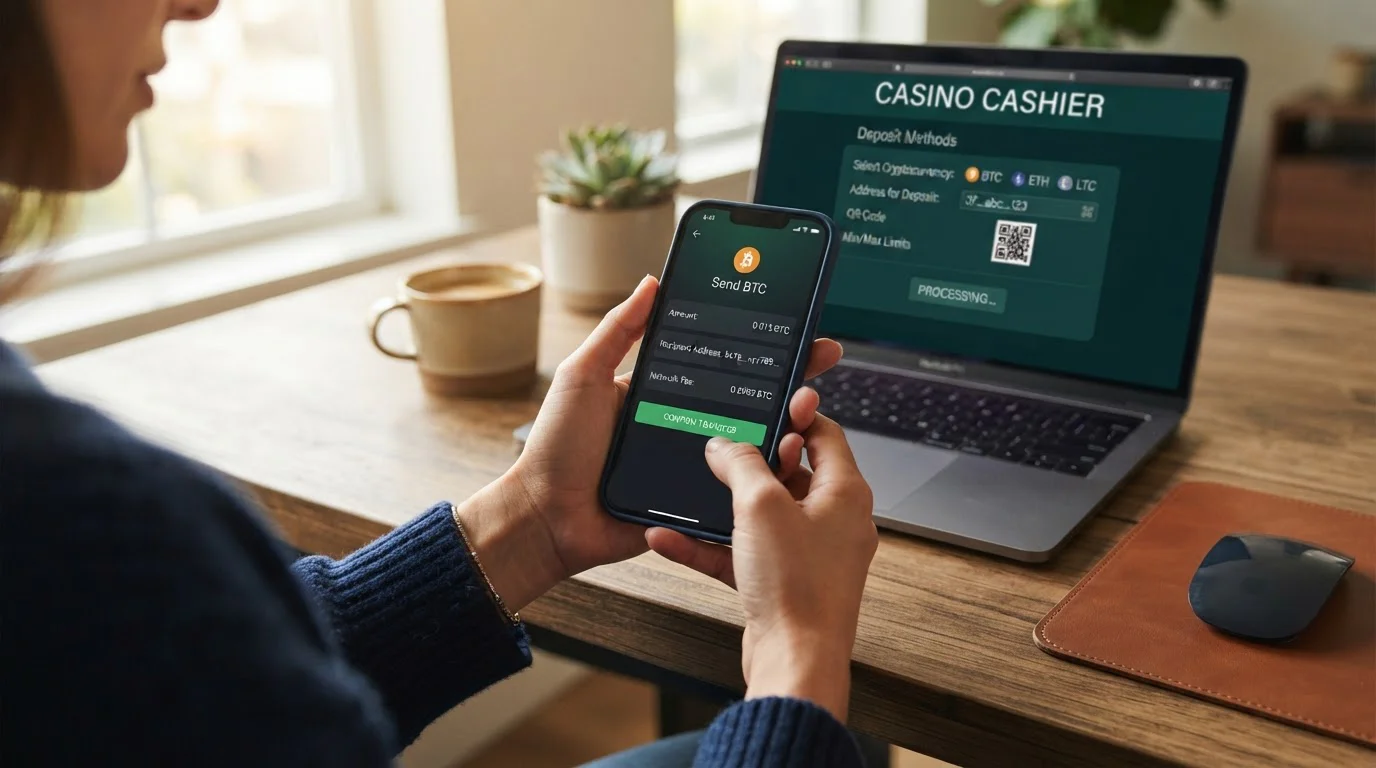
A crypto casino runs its cashier on blockchain rails instead of card processors and bank transfers. You send Bitcoin, Ethereum, or USDT from your wallet to the casino’s deposit address, the transaction confirms on the blockchain in minutes, and your account balance updates. Withdrawals reverse the flow — casino sends crypto back to your wallet address, you sell it on an Australian exchange for AUD if you want fiat, or you hold it as crypto. No bank sitting in the middle approving or declining the transaction.
The shift accelerated in June 2024 when Australian credit cards were banned for online gambling — sports betting and offshore casinos both. That move pushed players toward payment methods banks don’t control. E-wallets still work, but they route through processors that can freeze accounts or block gambling merchants under pressure from financial institutions. Crypto bypasses that entirely. The transaction is peer-to-peer once you hold the coins: your wallet to the casino’s wallet, recorded on a public ledger, irreversible once confirmed.
Three practical advantages drive adoption. Withdrawal speed collapses from three-to-five business days (cards and bank transfers) to under an hour for most cryptocurrencies, often under ten minutes. Privacy improves — blockchain transactions are pseudonymous, meaning your wallet address is public but your identity behind it is not, unless you connect your wallet to a KYC exchange. And bank friction disappears: no card decline, no “merchant category blocked” message, no compliance team freezing your account because a casino transaction triggered a fraud alert.
The trade-off is you’re responsible for security. Send crypto to the wrong address and there’s no chargeback. Fat-finger the network selection — Bitcoin mainnet vs Lightning Network, USDT on Ethereum vs Tron — and your deposit lands in the wrong place or gets stuck in limbo. Crypto casinos won’t refund operator error, and most won’t refund *your* error either. The “be your own bank” ethos applies: control means responsibility.
Australian exchanges like CoinSpot, Swyftx, and Independent Reserve let you convert AUD to Bitcoin, Ethereum, or USDT. AUSTRAC requires those exchanges to run KYC — passport or driver’s licence plus proof of address — so the fiat-to-crypto on-ramp isn’t anonymous. Once you hold the crypto, though, moving it from your wallet to a casino happens without an intermediary who can block the transfer. The casino sees a wallet address, not your name.
Offshore operators aren’t licensed in Australia because no online casino licence exists here. They’re licensed in Curaçao, Anjouan, Malta, or unregulated entirely, and they accept Australian players despite the IGA prohibition. Playing at one isn’t illegal *for you* — the law targets operators, not punters. ACMA blocks their domains, but VPNs and mirror sites keep them accessible. The risk is you’re outside Australian consumer protection if something goes wrong. No regulator to file a complaint with, no local enforcement, no guarantee you’ll get paid on a big win unless the operator chooses to pay you.
Crypto casinos work well until they don’t, and when they don’t, you’re holding the bag. That’s the honest trade: speed, privacy, and payment freedom in exchange for zero recourse if the operator decides to stall, demand unreasonable KYC after a big win, or disappear. The operators ranked above have operating histories measured in years, not weeks, and public complaint ratios that don’t scream “exit scam brewing.” But history isn’t a guarantee. Treat every deposit like money you can afford to lose, because offshore gambling has no safety net.
How Crypto Withdrawals Actually Work — Approval Time vs Blockchain Settlement
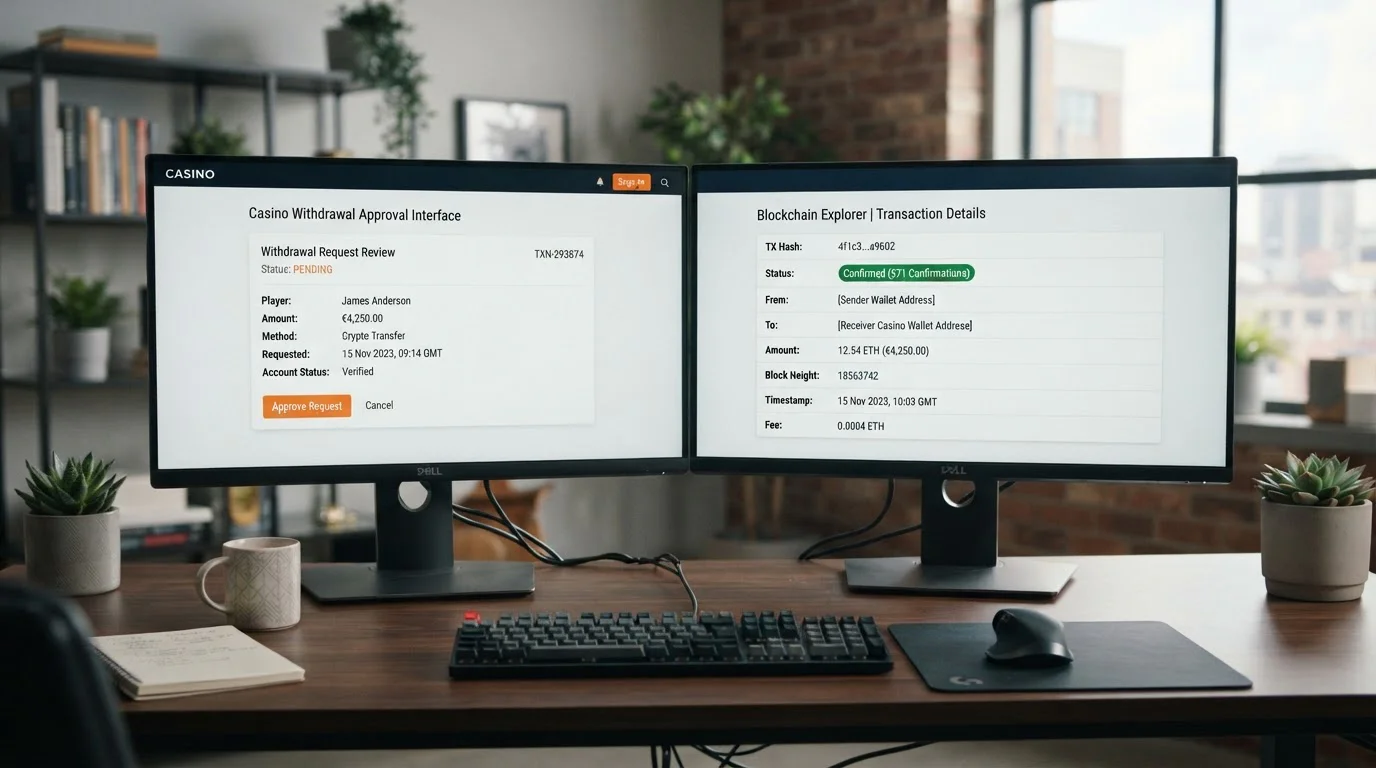
Casino marketing says “instant withdrawal,” which is technically true for the approval step and misleading for the total timeline. Withdrawals move through two phases: the casino approves your request and releases funds, then the blockchain network settles the transaction. The first part takes anywhere from zero to sixty minutes depending on the platform, your account status, and the withdrawal amount. The second part is network-dependent and outside the casino’s control.
Bitcoin settles in ten to sixty minutes because blocks mine roughly every ten minutes and most platforms require one to six confirmations before crediting your wallet. Ethereum takes three to fifteen minutes with twelve to thirty confirmations, but gas fees swing from $2 to $50 depending on network congestion. Litecoin clears in five to fifteen minutes at low fees. USDT on Tron (TRC-20) settles in under two minutes with near-zero fees, which makes it the fastest and cheapest option for moving money in and out of crypto casinos. Bitcoin Lightning Network also clears in under two minutes, but fewer casinos support it.
The approval step is where casinos reveal their character. BC.Game and BitStarz approve most standard withdrawals — under $1,000 USD equivalent — within minutes, often instantly. Vave and OnlySpins run slightly slower but still inside twenty minutes. The mid-tier operators push twenty-five to thirty minutes for approval, and large withdrawals anywhere in the field trigger manual review, which can stretch to hours or force a KYC check even if you’ve been playing without documents until now.
KYC slows everything. “No verification” casinos let you deposit and play without uploading a passport, but withdrawals above a certain threshold — usually $2,000 to $5,000 USD equivalent, though thresholds aren’t published — trigger a compliance check. You’ll get an email asking for ID, proof of address, and sometimes a selfie holding your ID next to the current date written on paper. That review takes anywhere from two hours to three days depending on the casino’s back-office staffing and how much your documents raise flags. Big wins attract extra scrutiny, and casinos reserve the right to request additional documents or close your account under vague “irregular play” clauses buried in the terms.
How long does a crypto withdrawal actually take from start to finish?
Small amounts at BC.Game or BitStarz: four to ten minutes total (instant approval plus blockchain settlement). Mid-tier operators with Bitcoin: thirty to sixty minutes (twenty-minute approval plus Bitcoin’s ten-to-sixty-minute settlement). Large amounts anywhere: add two hours to three days for KYC review if it’s your first big cashout, then the normal blockchain time on top. USDT on Tron consistently delivers the fastest end-to-end experience — under five minutes from request to wallet confirmation at casinos that approve quickly. Bitcoin is slower and more expensive but more widely supported. Ethereum sits in the middle: faster than Bitcoin, pricier than Tron.
Which cryptocurrency is fastest and cheapest for casino deposits and withdrawals?
| Cryptocurrency | Settlement Time | Network Fees | Best For |
|---|---|---|---|
| USDT (TRC-20) | <2 minutes | <$1 | Speed and cost (recommended) |
| Bitcoin Lightning | <2 minutes | <$0.01 | Instant small amounts (limited support) |
| Litecoin | 5–15 minutes | $0.05–$0.50 | Balance of speed and adoption |
| Bitcoin (mainnet) | 10–60 minutes | $1–$10 | Maximum compatibility |
| Ethereum | 3–15 minutes | $2–$50 | Avoid unless required |
USDT on Tron (TRC-20) wins on speed and cost unless the casino doesn’t support it, in which case Litecoin is the fallback. Bitcoin mainnet is the slowest and most expensive but accepted everywhere. Ethereum’s gas fees make it uncompetitive unless you’re already holding ETH and don’t want to convert. Lightning Network is fast and cheap when supported, but adoption remains patchy across crypto casinos. Check the casino’s deposit page before buying crypto — some platforms support USDT on Tron, others only USDT on Ethereum, and sending to the wrong network can lose your funds permanently.
KYC and Anonymous Play — When No Verification Actually Means No Verification

“No KYC” means you sign up with an email address, skip the document upload, and start playing immediately. No passport scan, no utility bill, no selfie verification. That’s true until you try to withdraw a meaningful amount, at which point most “no KYC” casinos become “KYC on demand” casinos.
Thresholds aren’t published. Operators don’t announce “we’ll ask for ID above $3,000” because that would invite structuring — splitting large withdrawals into smaller chunks to stay under the limit. Instead, the terms reserve the right to request verification “at any time” and “for any reason,” which in practice means: small regular withdrawals clear without hassle, your first big win triggers a compliance check, and cumulative volume over your account lifetime eventually crosses an invisible line that forces KYC even if individual withdrawals stay modest.
Industry patterns suggest thresholds sit somewhere between $2,000 and $5,000 USD equivalent for a first-time large withdrawal. Bet $50 spins and cash out $300? No documents. Hit a $12,000 pokie win on your third deposit? Expect an email requesting ID within hours. The exact trigger is platform-specific and tied to automated risk scoring — withdrawal size relative to deposit size, betting patterns, account age, payment method, jurisdiction. Winning big on your first session raises more flags than the same win after three months of regular play.
True anonymity requires avoiding KYC at every stage: buying crypto peer-to-peer or from a Bitcoin ATM instead of a regulated exchange, holding it in a self-custody wallet not linked to your identity, depositing directly to the casino without routing through a KYC exchange, and withdrawing to a clean wallet before converting back to fiat. AUSTRAC requires Australian crypto exchanges — CoinSpot, Swyftx, Independent Reserve — to collect ID on anyone converting AUD to crypto or crypto to AUD. That means the moment you on-ramp or off-ramp through a local exchange, there’s a KYC record linking your identity to the wallet address. The blockchain transaction to the casino is pseudonymous, but the endpoints are identified.
Peer-to-peer trades (LocalBitcoins, Bisq, in-person cash-for-crypto meetups) avoid exchange KYC but carry their own risks — counterparty fraud, pricing spreads, and the hassle of coordinating trades. Bitcoin ATMs let you buy crypto with cash and a phone number, no ID required under certain thresholds, but they charge 7–12% premiums and often have daily limits. Most Australian players prioritise convenience over perfect anonymity, which means using a KYC exchange to buy crypto and accepting that the fiat-to-crypto step leaves a trail even if the casino deposit doesn’t.
Do I need to verify my identity (KYC) at a crypto casino?
Not immediately, but eventually on large withdrawals or at the casino’s discretion. “No KYC” is marketing language that means “no mandatory verification at signup.” It does not mean “we will never ask for your ID.” Expect to provide documents if you win big, if your withdrawal-to-deposit ratio looks unusual, if you’re cashing out a large bonus, or if automated fraud detection flags your account. Have a government-issued ID and a recent utility bill ready before you hit a life-changing win, because the casino will almost certainly demand both before releasing funds. Refusing verification lets the casino void your balance under the terms you agreed to at signup. Offshore operators enforce their own rules, and there’s no Australian regulator to appeal to if you think the demand is unreasonable.
Bonuses and Wagering Requirements — What 40x Actually Means in Practice

A $1,000 welcome bonus at 40x wagering means you place $40,000 in bets before withdrawing a dollar of bonus funds or winnings derived from them. Not $40,000 in *profit* — $40,000 in *turnover*. If you bet $10 per spin and the slot returns $8, you’ve contributed $10 toward the rollover, not the $2 you lost. Forty thousand dollars of turnover at $10 per spin is four thousand spins.
Game contribution matters. Slots usually count 100% toward wagering requirements, so a $10 spin on a pokie contributes the full $10. Table games often count 10% or get excluded entirely, meaning a $100 blackjack hand contributes $10 to the rollover, or zero if blackjack is excluded from bonus play. Live dealer games almost always count 0%. Check the bonus terms for the contribution table — it’s usually buried three pages deep in the fine print, listed by game type or specific title.
Max bet rules cap individual wagers while a bonus is active, typically at $5 to $10 per spin or hand. Breaching that limit — even accidentally, even once — voids the bonus and any winnings tied to it. Most platforms enforce this automatically by capping your bet slider while bonus funds are in play, but some rely on backend detection and retroactively void balances after you’ve already cleared the rollover. The terms always favour the house: if the software lets you bet $15 per spin and you do, the casino reserves the right to call that a breach and confiscate everything.
Deposit-plus-bonus or bonus-only structures change the math. A “deposit + bonus” rollover at 40x means you wager forty times the combined total: deposit $500, get a $500 bonus, wager $40,000 before cashing out. A “bonus-only” rollover at 40x means you wager forty times the bonus alone: deposit $500, get a $500 bonus, wager $20,000. Bonus-only requirements are half as steep, but rarer. Most crypto casino bonuses use deposit-plus-bonus, which doubles the grind.
Time limits apply. Welcome bonuses usually expire in thirty days, meaning you clear the rollover or forfeit the bonus and any attached winnings within a month. High-stakes players can burn through $40,000 in turnover in a weekend. Casual $1-per-spin punters will never clear it. The casino’s actuarial models price this in — they expect most players to wager the bonus back to the house before meeting rollover, or to abandon the bonus and withdraw early, forfeiting the bonus credits.
Cashout caps limit how much you can withdraw from bonus winnings even after clearing rollover. A “win up to $5,000” cap on a no-deposit bonus means if you somehow turn $30 of free credit into $12,000, you’ll withdraw $5,000 and the rest gets voided. Deposit-bonus caps are less common but exist — usually 5x to 10x the bonus amount. A $1,000 bonus with a 5x cap means you can withdraw a maximum of $5,000 from that bonus, even if you hit a $50,000 progressive jackpot while the bonus was active. Read the cashout-cap section of the terms before opting into any offer.
The expected value of a bonus is almost always negative once you factor in wagering requirements, max bets, game restrictions, and cashout caps. The house gives you extra money in exchange for locking you into betting patterns that statistically return the “gift” plus a margin. Bonuses make sense if you were planning to deposit and play anyway and the bonus extends your session time. They don’t make sense if you’re chasing the bonus as profit — the math doesn’t work.
For players who want a clean experience, smaller no-strings deposits beat large bonus deposits. Deposit $200 with no bonus attached, play through it once at your natural pace, withdraw if you’re ahead. No rollover grind, no max-bet restrictions, no voided-balance surprises. The trade-off is you’re betting your own money without the bonus cushion, but you’re also free to cash out anytime without 40x rollover hanging over every spin.
The Legal Reality — IGA 2001, AUSTRAC, and What Enforcement Actually Targets

The Interactive Gambling Act 2001 prohibits anyone from providing online casino services — pokies, table games, live dealer — to persons physically in Australia. Section 15 makes it an offence to offer those services to customers in this country. Operators who advertise to Australians or accept Australian signups are breaking the law, and ACMA enforces it by blocking domains and issuing fines. That’s the supply-side prohibition. The law targets service providers, not customers.
Playing at an offshore casino is not illegal for you under federal law. The IGA criminalises *providing* the service, not *using* it. No Australian has been prosecuted for placing a bet at an offshore platform, and no provision in the Act makes it an offence to gamble online as an individual. ACMA blocks access and chases operators, but enforcement stops at the supply side. You won’t be fined or charged for playing pokies at a Curaçao-licensed crypto casino from your living room in Sydney.
State and territory gambling laws vary, but none criminalise using an offshore platform. Some impose advertising restrictions or create licensing frameworks for local operators, but the end-user behaviour — logging in, depositing, spinning reels — falls outside the scope of criminal enforcement. The legal risk sits with the operator, not the player.
AUSTRAC regulates cryptocurrency exchanges and wallet providers under anti-money-laundering obligations, not gambling. Digital Currency Exchange providers — platforms that convert AUD to Bitcoin, Ethereum, or USDT — have been required to register with AUSTRAC since April 2018. As of July 2026, crypto-to-crypto exchanges and custody providers also need AUSTRAC registration. Those rules exist to prevent money laundering and terrorist financing, and they impose KYC requirements on the fiat-to-crypto on-ramp.
AUSTRAC registration is *not* a casino licence. CoinSpot, Swyftx, and Independent Reserve are AUSTRAC-registered because they exchange fiat for crypto, not because they have anything to do with gambling. Offshore casinos are not AUSTRAC-registered. They operate under offshore licences — Curaçao, Anjouan, Malta — and accept crypto deposits from Australian wallets without running their own Australian entity. The payment rail involves an AUSTRAC-registered exchange on your side (when you buy the crypto), but the casino itself sits outside AUSTRAC’s jurisdiction.
No state or territory in Australia issues a licence for online casino products. The Northern Territory Racing Commission licenses sports betting (wagering), not pokies or table games. Queensland, NSW, Victoria, SA, WA, Tasmania, ACT — none offer an online casino licence. Land-based venues operate under state gaming licences, but those don’t extend to internet delivery of casino games to customers at home. The result is zero legal online casinos in Australia. Every platform accepting Australian players for pokies or blackjack is offshore and operating in defiance of the IGA’s supply-side prohibition.
Are crypto casinos legal for Australian players in 2026?
Playing at an offshore crypto casino is not illegal for you. The Interactive Gambling Act prohibits operators from offering services to Australians, but the law does not criminalise individuals for using those services. ACMA blocks domains and fines operators who advertise in Australia, but individual players face no criminal or civil penalties under federal law. You’re outside Australian consumer protection, so there’s no regulator to appeal to if the casino refuses to pay out or closes your account, but using the platform itself is not a crime. State laws don’t criminalise it either. The risk is commercial and reputational (dealing with an offshore operator who may or may not honour withdrawals), not legal.
Can I play at offshore crypto casinos using an Australian bank account?
Not directly. Credit cards were banned for online gambling in June 2024, and Australian banks generally block or decline transactions to offshore casino merchants even for debit cards and transfers. The crypto workaround is: buy Bitcoin, Ethereum, or USDT on an Australian exchange (CoinSpot, Swyftx, Independent Reserve), transfer the crypto to your personal wallet, then send from your wallet to the casino’s deposit address. The bank sees a transfer to a registered crypto exchange, not a casino. The exchange sees a crypto purchase and withdrawal to your wallet, not a gambling transaction. The casino sees a crypto deposit from an anonymous wallet address, not your bank account. That separation is why crypto bypasses the bank-friction problem: no direct connection between your AUD bank account and the offshore casino exists.
Crypto Pokies and Game Selection — What to Expect

Crypto casinos run the same pokies you’d find at a traditional online casino — Pragmatic Play, NetEnt, Play’n GO, BGaming, Hacksaw Gaming, Nolimit City, Push Gaming, and dozens of other studios supply the catalogue. Popular titles like Gates of Olympus, Sweet Bonanza, Big Bass Bonanza, The Dog House Megaways, and Book of Dead are standard across every platform in this set. Live dealer tables come from Evolution Gaming, Pragmatic Play Live, and Ezugi, with the usual blackjack, roulette, baccarat, and game-show variants.
The difference is payment rail, not game selection. You’re playing the exact same RNG-certified pokies, just funding your account with Bitcoin instead of a Visa card. RTP (Return to Player) percentages are set by the game studio, not the casino, so Gates of Olympus runs at 96.5% RTP whether you’re playing at BC.Game with crypto or a European casino with euros. Crypto doesn’t change the math of the games.
Provably fair games are the exception. BC.Game, Vave, and a few others offer in-house titles — Crash, Dice, Plinko, Mines, Limbo — where the outcome is generated via a cryptographic hash published before you place the bet. After the round finishes, the casino reveals the seed, and you can verify the result wasn’t tampered with by running the hash yourself. Traditional pokies are certified by third-party testing labs (eCOGRA, iTech Labs, GLI) but sealed black boxes — you trust the RNG without being able to verify each spin. Provably fair games publish the hash, so you can independently confirm the house didn’t cheat.
The trade-off is provably fair games are simpler — dice rolls, coin flips, multiplier curves — because the cryptographic verification requires straightforward outcomes. You won’t find a provably fair version of a 243-ways video pokie with cascading reels and free-spin features. The tech doesn’t scale to complex RNG games. But for players who want transparency over spectacle, Crash and Dice at 99% RTP beat any pokie on mathematical expectation.
Game counts in the tables above are marketing figures and shouldn’t be taken literally. BitStarz lists 7,387 games, but that includes every variant of every title — Buffalo King base game, Buffalo King Megaways, Buffalo King Untamed Megaways all count as separate entries. The actual number of meaningfully distinct games is lower, often by half. Still, every platform here offers thousands of pokies, dozens of live dealer tables, and the standard table-game roster (blackjack, roulette, baccarat, poker variants). You won’t run out of options unless you’re aggressively completionist.
Slot volatility matters more than game count. High-volatility pokies (The Dog House Megaways, Dead or Alive 2, San Quentin xWays) pay out infrequently but hit harder when they do, which suits players chasing big multipliers and willing to burn through their balance on dry spells. Low-volatility pokies (Starburst, Blood Suckers, Jack Hammer) pay smaller wins more consistently, which extends session time but caps upside. Match volatility to bankroll size: high variance on a thin bankroll ends your session fast, low variance on a large bankroll bores you before you hit anything meaningful.
Progressive jackpots are rare at crypto casinos because most operate outside the network of licensed operators who pool jackpot contributions. Mega Moolah, Hall of Gods, and the other big Microgaming progressives don’t appear at offshore platforms. A few crypto casinos run their own in-house progressives, but the prize pools are smaller because the player base is smaller. Expect five-figure jackpots, not the seven-figure prizes that headline land-based and European-licensed online casinos.
Mobile play works via browser, not app. Apple and Google ban real-money gambling apps on the Australian App Store and Google Play unless the developer holds a state-issued licence, which offshore operators don’t. Every platform in this set runs a mobile-optimised website that loads in Safari or Chrome on your phone. The experience is app-quality — touch-optimised, persistent login, fast load times — but delivered via browser to sidestep app-store restrictions. Bookmark the site on your home screen and it behaves like a native app, minus the App Store download.
Australian-friendly features vary. Some platforms show balances in AUD equivalents even when your account holds Bitcoin or USDT. Others default to BTC denomination, which requires mental conversion every time you check your balance. OnlySpins accepts AUD directly, so you never leave fiat. The rest are crypto-native and force you to think in satoshis or USDT. Time-zone display is usually UTC, not AEST, so live-dealer peak hours and promotion schedules require adjustment. Customer support runs 24/7 via live chat on most platforms, but response quality and English fluency vary. Expect instant replies on BC.Game and BitStarz, slower service on mid-tier operators.
Responsible gambling tools exist but are self-imposed. No BetStop integration — that’s a licensed-operator system that doesn’t cover offshore platforms. You set deposit limits, loss limits, and session time limits in your account settings, but enforcement is software-based, not regulatory. If you hit a limit and want to raise it, the casino will likely let you, often immediately or after a short cooling-off period. Self-exclusion works the same way: you can request to be locked out for a set period, but there’s no national self-exclusion registry linking offshore operators, so closing your account at BC.Game doesn’t prevent you from opening one at BitStarz the next day. Responsible gambling at offshore casinos is purely willpower-based. No external framework stops you if you’re determined to keep playing.
The game selection is broad, the payment rail is fast, and the legal ambiguity is the price of admission. Crypto casinos offer the same pokies as licensed operators, just without the licensing. Whether that trade-off makes sense depends on how much you value speed and privacy versus consumer protection and regulatory oversight. The operators ranked above deliver the product reliably. They won’t deliver a safety net if something goes wrong.
Crypto Casinos Australia 2026 — Bitcoin, Ethereum, USDT, Solana
Content created by the «Aussie Cashier» team