
No Minimum Deposit Casino Australia: The Real Entry Barriers in 2026
 Available in AU

A$5 deposit advertised, A$10 Neosurf voucher minimum, A$50 withdrawal gate. The arithmetic doesn’t work, but the marketing does. No Australian online casino exists — the Interactive Gambling Act killed that in 2001 — so every site taking your money operates offshore, unlicensed, and bound by payment-rail economics that make “no minimum deposit” a literal impossibility. What you get instead: deposit floors between A$10 and A$30, bonus activation thresholds higher than deposit minimums, and withdrawal gates that define your real test cost.
The list here maps ten offshore casinos by actual deposit floor, breaks down payment-method minimums (Neosurf voucher denominations, PayID casino-side gates, crypto network fees), and explains the three-layer friction model that makes a A$10 deposit cost A$50 to verify. No hype. The regulator doesn’t license these sites, the law doesn’t sanction them, and the cheapest entry point still runs you more than the headline.
What “No Minimum Deposit” Actually Means in Australia
The phrase sells itself. Operators plaster “no minimum deposit” across landing pages, affiliate sites rank them by it, and the claim survives contact with reality for exactly as long as it takes you to open a cashier. Then the friction starts.
Three separate barriers sit between you and a functional test. The deposit floor is what the cashier accepts — the lowest top-up the payment processor and casino will process. For Neosurf, that’s A$10 because vouchers don’t come smaller. For PayID, casinos set A$10 to A$50 gates even though the New Payments Platform handles $0.01 transfers. For crypto, 0.0001 BTC sounds like “no minimum” until you pay A$15 in network fees on a A$10 equivalent deposit. The deposit floor is marketing’s favourite number because it’s the smallest.
The bonus activation threshold is where you qualify for the welcome package. Deposit A$10, trigger nothing. Deposit A$30 or A$50, unlock the match bonus and free spins. Operators quietly set this gate above the deposit floor, so the “minimum” becomes the maximum amount you can lose without touching a promotion. Not advertised, rarely disclosed upfront, always higher.
The withdrawal minimum is the test-cost ceiling. You deposit A$10, run it to A$25, try to cashout — request denied, minimum withdrawal A$50. Deposit another A$25 to hit the gate, verify the site pays, then decide if it’s worth keeping. That A$50 withdrawal minimum is your real entry cost, not the A$10 deposit the headline promised. The casino lets you in cheap and charges you to leave.
Worked example: Operator A advertises A$10 minimum deposit. You load A$10 via Neosurf, play through it, hit A$30. Cashier says withdrawal minimum A$50. You deposit another A$20, play to A$52, request payout. KYC asks for ID, you submit, wait two days, funds land. Total test cost: A$30 deposited, A$52 withdrawn, net A$22 profit — but the verification cost was A$30, not A$10. The marketing lied by omission.
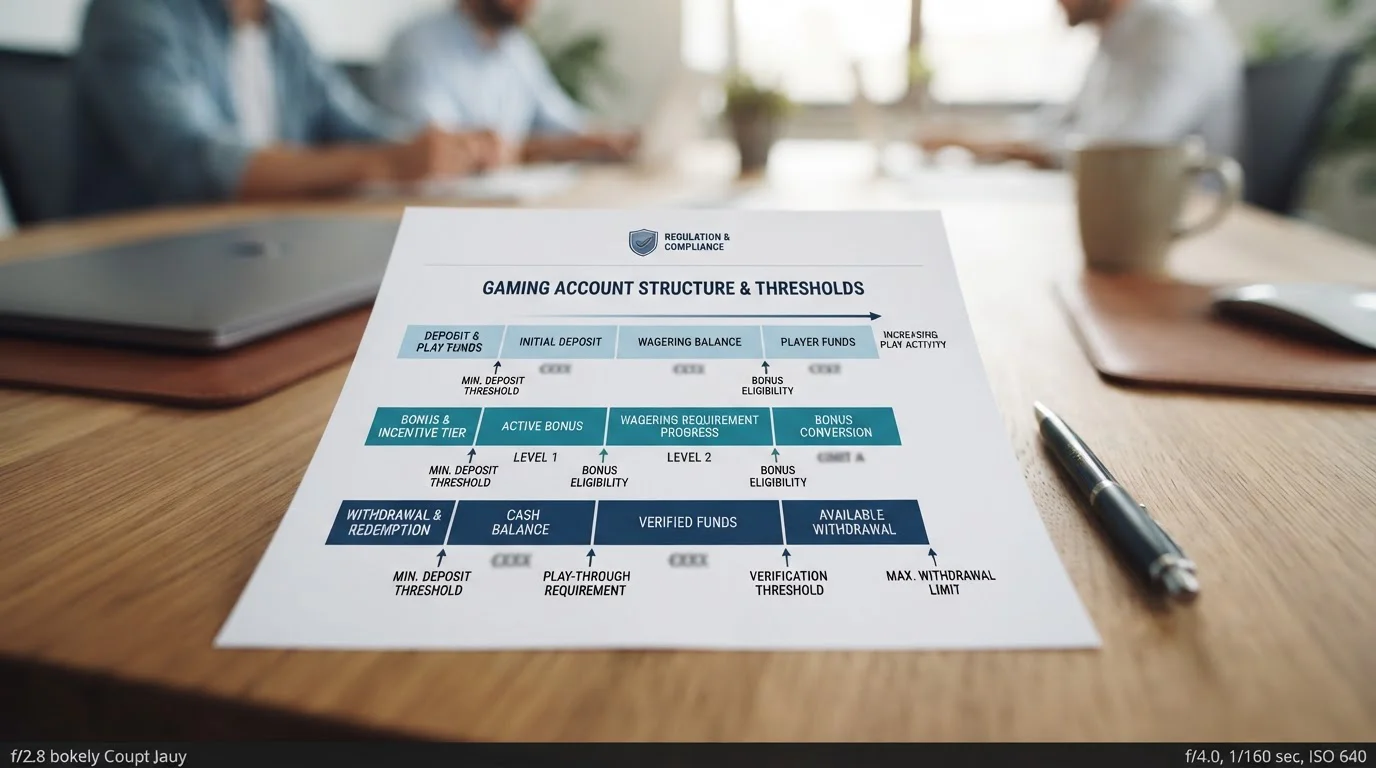
The table below maps all three barriers across ten operators. “Functional test cost” is the withdrawal minimum — the floor you must reach to verify the site actually pays.
| Operator | Deposit Floor | Bonus Activation Threshold | Withdrawal Minimum | Functional Test Cost |
|---|---|---|---|---|
| RollXo | A$10 | A$30 | A$50 | A$50 |
| VegasNow | A$10 | A$20 | A$50 | A$50 |
| Spinsy | A$15 | A$20 | A$30 | A$30 |
| Rooli | A$15 | A$30 | A$50 | A$50 |
| N1 Bet | A$15 | A$20 | A$25 | A$25 |
| Hell Spin | A$20 | A$20 | A$50 | A$50 |
| BitStarz | A$20 | A$20 | A$50 | A$50 |
| 7Bit | A$20 | A$20 | A$50 | A$50 |
| PlayMojo | A$20 | A$30 | A$50 | A$50 |
| Kingmaker | A$32 | A$32 | A$64 | A$64 |
What does “no minimum deposit” actually mean at Australian online casinos?
It means deposit floors between A$10 and A$30, not zero. Payment processors enforce minimums (Neosurf vouchers start at A$10, card processors set A$10–A$20 gambling-merchant floors), casinos layer bonus gates above deposit minimums, and withdrawal minimums define your real test cost. A site advertising “no minimum” typically accepts A$10–A$20 deposits but won’t let you withdraw until you hit A$25–A$100 balance.
The Three-Layer Friction Model
Deposit floor, bonus gate, withdrawal minimum. Three numbers, three purposes. The deposit floor gets you in, the bonus gate sells you the promotion, the withdrawal minimum extracts verification cost. Operators benefit when these numbers diverge: a A$10 deposit floor with a A$50 withdrawal minimum means you’re testing with A$50, not A$10, but the marketing headline stays low.
The model isn’t universal. N1 Bet runs a tight spread: A$15 deposit, A$25 withdrawal minimum — only A$10 gap. Kingmaker doubles every figure: €20 deposit, €64 withdrawal minimum, bonus gate matches deposit floor. RollXo advertises A$10 Neosurf deposits but sets a A$30 bonus gate and A$50 withdrawal floor — classic wide spread, maximum friction.
Why the gap exists: deposit floors are competitive (players compare them in public sources), bonus gates are disclosed in fine print, withdrawal minimums hide in cashier dropdowns. The first number sells, the last number costs. Operators compete on the wrong metric and pocket the difference.
Why A$5 Deposits Don’t Exist
Payment rails don’t support them. Neosurf vouchers are sold in A$10, A$20, A$50, A$100, A$250 denominations — no A$5 option at retail. Card processors (Visa, Mastercard) set A$10–A$20 gambling-merchant minimums to reduce chargebacks and compliance overhead on micro-transactions. PayID has no network-level floor (the NPP handles $0.01 transfers), but every casino surveyed sets a A$10–A$50 gate on their end.
Crypto looks like the exception. BitStarz, 7Bit, and Hell Spin technically accept 0.0001 BTC (~A$10 at September 2026 rates), and some operators quote “no minimum” for Bitcoin deposits. The network fee kills it. Sending 0.0001 BTC costs 0.00005–0.0001 BTC in miner fees depending on congestion — A$8 to A$15 at current rates. Deposit A$10 worth of BTC, pay A$15 to move it, net loss before you spin. The functional crypto minimum is A$25–A$30 once fees are accounted for.
Stablecoins on low-fee chains (USDT on Tron TRC-20, USDC on Binance Smart Chain) break A$5 with sub-A$1 fees, but operator adoption lags. Most crypto casinos still route through Bitcoin and Ethereum, both prohibitively expensive for sub-A$20 deposits in 2026.
The Functional Test Cost
How much does it cost to verify a casino pays? Not the deposit floor. The withdrawal minimum. If you can’t extract funds until you hit A$50 balance, your test costs A$50 regardless of whether you got there via one A$50 deposit or five A$10 top-ups. The marketing emphasises the deposit floor because it’s smaller and more competitive; the cashier enforces the withdrawal minimum because that’s the gate the site actually cares about.
Two operators stand out for tight spreads. N1 Bet: A$15 deposit, A$25 withdrawal minimum, A$10 gap. Spinsy: A$15 deposit, A$30 withdrawal minimum, A$15 gap. Everyone else runs A$30–A$50 gaps between deposit floor and cashout gate, which means the test costs 2x–5x the advertised entry point. RollXo and VegasNow advertise A$10 Neosurf minimums but enforce A$50 withdrawal gates — a 5x multiplier on test cost. BitStarz, Hell Spin, and PlayMojo all set A$20 deposit floors with A$50 withdrawal minimums — 2.5x multiplier.
The gap exists because operators face fixed costs per payout: KYC document review (manual staff time or automated verification service fees), AML transaction screening, payment-processor per-transaction charges (A$2–A$5 for bank transfers, lower for crypto but still non-zero), and fraud-prevention overhead. Processing a A$25 withdrawal costs the operator roughly the same as processing A$500, so they set minimums high enough to amortise fixed costs across fewer, larger transactions. Players bear the cost via capital lockup.
Players optimising for cheapest verification should rank by withdrawal minimum, not deposit floor. A site with a A$20 deposit floor and A$25 withdrawal minimum (N1 Bet) costs less to test than a site with a A$10 deposit floor and A$50 withdrawal minimum (RollXo, VegasNow). The public review ranks by the wrong number.
10 Offshore Casinos Ranked by Deposit Floor

Every site here operates without an Australian license. The Interactive Gambling Act 2001 prohibits local operators from offering online casino services to Australian residents, so these ten hold Curaçao licenses, target Australians via .au mirrors and AUD cashiers, and sit outside ACMA’s jurisdiction until the regulator blocks their domains. Ranking is by deposit floor, then by functional test cost (withdrawal minimum) where floors tie.
| Operator | License | Withdrawal Speed | Minimum Deposit | Distinguishing Feature |
|---|---|---|---|---|
| RollXo | Antillephone 8048/JAZ | Crypto <24h, e-wallet 24–48h | A$10 Neosurf | Fast crypto withdrawals, low Neosurf floor |
| VegasNow | Curaçao eGaming | Crypto 24h, e-wallet 24–48h | A$10 Neosurf | Neosurf-optimized cashier |
| Spinsy | Curaçao eGaming | Crypto 24h, e-wallet 24–48h | A$15 Neosurf/e-wallet | 10,000+ games, AU sports betting |
| Rooli | Curaçao eGaming | E-wallet 24–48h | A$15 e-wallet | E-wallet focus, no bank statements |
| N1 Bet | Curaçao eGaming | Crypto <24h, PayID 1–4h | A$15 multi-method | N1 Interactive network, sportsbook combo |
| Hell Spin | Curaçao eGaming | Crypto <1h | A$20 all methods | 10+ cryptos, Hollycorn N.V. operator |
| BitStarz | Curaçao OGL/2024/165/0185 | Crypto 10–60 min | A$20 or BTC equivalent | Since 2014, Direx N.V., dual AUD/crypto |
| 7Bit | Curaçao eGaming | Crypto <1h, fiat 1–3 days | A$20 or 0.0001 BTC | Dama N.V., crypto-native |
| PlayMojo | Curaçao eGaming | PayID 1–4h | A$20 PayID, A$30 cards | 10,000+ games, PayID-optimized |
| Kingmaker | Curaçao eGaming | Crypto 24h, cards 3–5 days | €20 (~A$32) | EUR-primary, mid-tier threshold |
RollXo Casino
RollXo operates under Antillephone N.V. license No. 8048/JAZ, a Curaçao Gaming Control Board sublicensee. Established around 2020–2021, the site runs 4,000–5,000 pokies and live dealer tables from 60+ providers including Pragmatic Play, NetEnt, and Evolution Gaming. Corporate ownership beyond the Curaçao registry isn’t publicly disclosed, standard for offshore operators in this tier.
The deposit floor sits at A$10 via Neosurf — tied for lowest among operators surveyed — but bonus eligibility starts at A$30, and the withdrawal minimum is A$50. That A$40 spread between advertised entry and functional test cost is the widest on this list. The welcome package scales to AU$22,500 across multiple deposits with 350 free spins, but the 5x cash wagering and 30x–40x bonus wagering mean low-deposit players testing the site with A$10–A$20 won’t touch the promotion. Crypto payouts clear in under 24 hours per user reports; e-wallets take 24–48 hours. The speed advantage on crypto withdrawals is real and positions RollXo competitively for players prioritising fast verification over deposit size.
VegasNow Casino
VegasNow launched around 2021 with a Neosurf-optimized cashier and a A$10 voucher minimum, matching RollXo for lowest entry. The Curaçao eGaming license is current as of September 2026; ownership details aren’t public. Game library runs 4,000–5,000 titles from 50+ providers, standard depth for this market segment.
The A$10 Neosurf floor appeals to voucher-preferring players avoiding bank-statement entries, but the A$50 withdrawal minimum and 35x bonus wagering replicate the friction model seen across most competitors. Welcome package value sits between AU$3,000 and AU$5,000 depending on promotional period. Withdrawals: crypto within 24 hours, e-wallets 24–48 hours. The Neosurf focus is the distinguishing angle; if you’re buying vouchers at retail and want the lowest denominations accepted, VegasNow and RollXo are the two viable options at A$10. Everyone else starts at A$15 or A$20.
Spinsy Casino
Spinsy operates under Curaçao eGaming with a game library north of 9,000–10,000 titles — the largest among surveyed operators. Established around 2021–2022, the site integrates a sportsbook with AFL, NRL, and cricket markets alongside 70+ casino providers including Pragmatic Play, Evolution, NetEnt, and Play’n GO.
Minimum deposit sits at A$15 via Neosurf or Skrill/Neteller, with a A$20 floor for Bitcoin. The withdrawal minimum is A$30 — tightest gap after N1 Bet — making Spinsy cheaper to test than competitors with A$50 cashout gates. Welcome package scales to 100% up to AU$7,500 plus 200 free spins, with 30x bonus wagering. AUD is native, PayID is accepted, and crypto withdrawals clear within 24 hours. The 10,000+ game count and AU sports betting combination target players wanting casino and sportsbook under one account. If volume matters and you want sub-A$20 deposits with a low withdrawal gate, Spinsy delivers.
Rooli Casino
Rooli runs on a Curaçao eGaming sublicense with 5,000+ games from Pragmatic Play, NetEnt, Microgaming, and Evolution Gaming. Established around 2020, the site optimises for e-wallets — Skrill, Neteller, MuchBetter — with a A$15 minimum across those methods. Card and bank deposits sit higher.
The e-wallet focus appeals to players avoiding casino entries on bank statements. A$15 deposit floor is competitive, but the A$50 withdrawal minimum and 35x–40x bonus wagering replicate the standard offshore friction model. Welcome package value ranges AU$5,000–AU$10,000 depending on promotional cycle; exact terms shift frequently. E-wallet withdrawals process in 24–48 hours. The appeal is narrow: if you’re using e-wallets specifically to maintain payment anonymity and want a deposit floor under A$20, Rooli works. Otherwise, Spinsy or N1 Bet offer comparable minimums with broader payment-method coverage.
N1 Bet Casino
N1 Bet is part of the N1 Interactive Ltd network, a Malta-based parent operating 20+ casino brands with MGA and UKGC licenses for EU and UK markets. Australian players access the Curaçao-licensed version, unlicensed locally per the IGA but benefiting from group infrastructure — faster KYC processing, reliable payout track record, consolidated compliance systems.
Minimum deposit sits at A$15 across most methods, with a A$25 withdrawal minimum — the tightest spread on this list. That A$10 gap makes N1 Bet the cheapest site to verify: deposit A$15, run it to A$26, cashout, test complete for A$15 entry. Welcome package scales to ~AU$4,000 with free spins; 30x–35x bonus wagering is standard. The sportsbook integrates with the casino under one account, and the 7,000+ game library from 70+ providers (Pragmatic Play, NetEnt, Microgaming, Evolution, Play’n GO) covers the genre spread. Crypto withdrawals clear under 24 hours, PayID in 1–4 hours. N1 Interactive’s multi-brand scale shows in the operational smoothness — fewer payment hiccups, fewer KYC delays, fewer “contact support” loops than single-brand operators.
Hell Spin Casino
Hell Spin launched in 2021 under the Hollycorn N.V. umbrella, holding a Curaçao eGaming sublicense current through September 2026. The crypto-first positioning stands out: 10+ cryptocurrencies accepted (BTC, ETH, LTC, USDT, DOGE), crypto withdrawals quoted under one hour for verified accounts, and a flat A$20 minimum across all payment methods — no tiering by rail.
Game library runs 3,500+ titles from 50+ providers including Pragmatic Play, NetEnt, BGaming, and Evolution Gaming. Welcome package totals ~AU$1,200 plus free spins with 40x bonus wagering. The A$20 deposit floor sits mid-pack, but the crypto withdrawal speed (sub-60-minute average) is the fastest verified claim among operators surveyed. PayID is accepted for AUD players. The appeal is speed: if you’re testing with crypto and want same-day verification, Hell Spin delivers. If you’re using Neosurf or e-wallets, cheaper deposit floors exist elsewhere.
BitStarz Casino
BitStarz has operated since 2014 under Curaçao licensing, currently holding Curaçao Gaming Authority license OGL/2024/165/0185 issued in 2024 as a renewal of the original 2014 license. Direx N.V. is the operating entity. The 10+ year track record is the longest among operators on this list, and the operational stability shows: 6,000–6,500 games from 87 providers, dual AUD/crypto account currency (play in native BTC/ETH balance or convert to AUD), and crypto withdrawals consistently clearing in 10–60 minutes per user reports and third-party reviews. The site introduced provably fair gaming verification in 2015, letting players audit RNG outcomes via cryptographic hashes — a transparency feature absent from most competitors.
Minimum deposit is A$20 or equivalent in 15+ supported cryptocurrencies (BTC, ETH, LTC, BCH, DOGE, USDT, TRX, XRP, ADA, BNB, SOL, USDC). Welcome package scales to AU$2,000 or 5 BTC plus 180 free spins across four deposits, with 40x bonus wagering. The A$50 withdrawal minimum is standard. KYC processing typically completes within 24 hours for document submissions via the account dashboard; crypto-to-crypto transactions under A$2,000 aggregate often skip verification entirely. What distinguishes BitStarz is longevity and execution consistency — a decade of payouts without major scandals, fast crypto processing that actually meets quoted timelines, and a provider roster (87 studios) deeper than most competitors. The live chat support runs 24/7 with average response times under 2 minutes per user reports. If you’re prioritising operational trust over the lowest possible deposit floor, BitStarz justifies the A$20 entry.
7Bit Casino
7Bit runs under Curaçao eGaming as part of the Dama N.V. network, which operates 10+ sister brands with 7Bit as the crypto flagship. Launched in 2014, the site holds 5,000+ games from 60+ providers including Pragmatic Play, NetEnt, Microgaming, and Evolution Gaming. The technical minimum deposit is 0.0001 BTC (~A$10 at September 2026 BTC/AUD rates), but network fees (A$8–A$25 depending on congestion) make the functional floor A$20–A$30.
Welcome package totals ~1.5 BTC or AU$3,000 equivalent with 40x wagering. Withdrawals clear in under an hour for crypto, 1–3 days for fiat. The crypto-native positioning means BTC is the default account currency; AUD is accepted but the UX steers toward crypto. If you’re already holding Bitcoin and want to deposit without converting to fiat, 7Bit works. If you’re starting from AUD and buying crypto specifically to access a “low minimum,” the network fees erase the advantage — you’d pay less depositing A$20 via Neosurf at RollXo than A$10 worth of BTC at 7Bit once fees are factored in.
PlayMojo Casino
PlayMojo launched around 2020–2021 with a Curaçao eGaming license and a 10,000+ game library from 80+ providers — tied with Spinsy for largest surveyed collection. The PayID-optimized cashier sets a A$20 minimum for PayID transfers and A$30 for cards, with PayID withdrawals clearing in 1–4 hours for verified accounts.
Welcome package ranges 100% up to AU$2,000 or AU$5,000 (varies by promotional period) plus 100–300 free spins, with 30x–35x bonus wagering. The A$50 withdrawal minimum is standard. The PayID focus is the selling point: many offshore operators set A$30–A$50 PayID gates, so PlayMojo’s A$20 floor is competitive for players prioritising instant AUD bank transfers. The game library depth (10,000+ titles) rivals Spinsy, and the provider roster (Pragmatic Play, NetEnt, Microgaming, Evolution, Play’n GO) covers all major studios. If you’re using PayID and want the lowest casino-side minimum, PlayMojo and N1 Bet (A$15 floor, broader method coverage) are the two options under A$25.
Kingmaker Casino
Kingmaker operates under Curaçao eGaming with a EUR-primary cashier that accepts AUD but prices everything in euros. Minimum deposit is €20 (~A$32 at September 2026 EUR/AUD rates), with a €64 (~A$100+) withdrawal minimum — the highest functional test cost on this list. Established around 2019–2020, the site runs 3,000–4,000 games from Pragmatic Play, NetEnt, and Evolution Gaming.
Welcome package offers 100% up to €500 (~AU$800) plus 50 free spins with 35x bonus wagering. Withdrawals: crypto within 24 hours, cards 3–5 days. The EUR pricing positions Kingmaker as mid-tier on deposit thresholds when converted to AUD, and the high withdrawal minimum makes it the most expensive site to verify among operators surveyed. The appeal is limited unless you’re already transacting in euros or prefer EUR account currency; for AUD players seeking low deposit floors, every other operator on this list offers better entry terms.
Payment Methods and Their Real Minimums
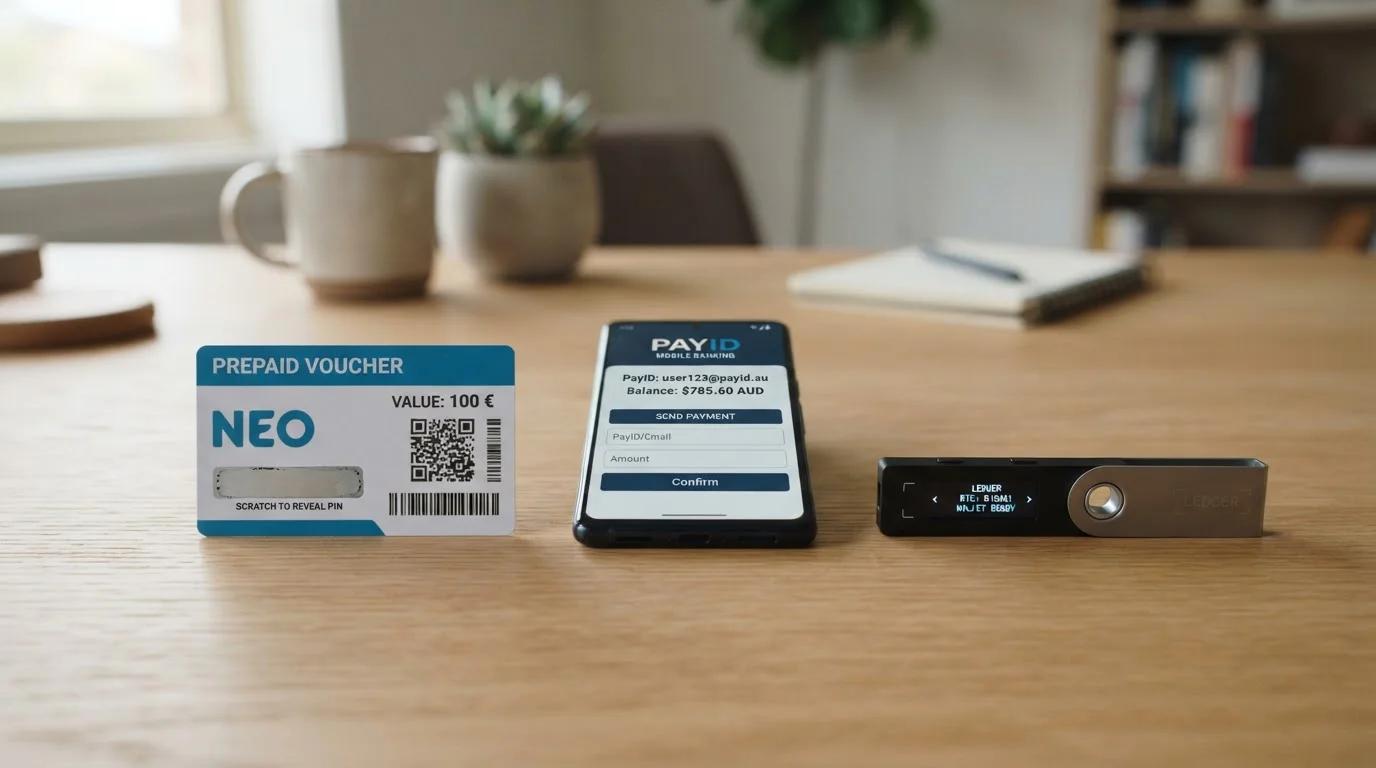
Deposit floors don’t emerge from operator generosity. They’re set by payment-rail economics: what the network charges to move money, what the processor requires to handle gambling transactions, what the voucher comes in at retail. Three methods dominate the Australian offshore market — Neosurf vouchers, PayID instant bank transfers, cryptocurrency — and each has a floor the marketing can’t override.
| Method | Network Minimum | Casino-Side Minimum | Withdrawal Speed | Fees | Anonymity |
|---|---|---|---|---|---|
| Neosurf | A$10 voucher | A$10–A$15 | Deposit-only (no withdrawals) | 0% at purchase, 2–5% cashier fee | High (no bank link) |
| PayID (NPP) | $0.01 technically | A$10–A$50 casino gate | 1–4 hours | 0% network, 0–2% casino | Low (direct bank link) |
| Bitcoin (BTC) | None technically | A$20–A$30 effective | 10 min – 2 hours | A$8–A$25 network fee per tx | Medium (pseudonymous) |
| Ethereum (ETH) | None technically | A$25–A$40 effective | 2–15 minutes | A$5–A$20 network fee per tx | Medium (pseudonymous) |
| USDT (TRC-20) | None technically | A$5–A$10 effective | 2–5 minutes | A$0.50–A$2 network fee | Medium (pseudonymous) |
| Cards (Visa/MC) | A$10–A$20 processor | A$20–A$30 | 3–5 days | 2–5% processing fee | Low (bank statement) |
| E-wallets (Skrill) | A$10 typical | A$15–A$30 | 24–48 hours | 0–2.5% | Medium (third-party account) |
Neosurf — The A$10 Voucher Floor
Neosurf is a prepaid voucher sold at retail (newsagents, petrol stations, convenience stores across Australia) in fixed denominations: A$10, A$20, A$50, A$100, A$250. You buy a voucher, receive a 10-digit PIN, enter it in the casino cashier, funds post instantly. No bank account link, no statement entry, no chargeback risk for the operator. Anonymity is the value proposition; the voucher floor is the constraint.
The A$10 denomination sets the network minimum. Casinos can’t accept less because Neosurf doesn’t sell smaller vouchers. RollXo and VegasNow set their deposit floors at A$10, matching the voucher minimum. Spinsy and Rooli set theirs at A$15, requiring players to buy a A$20 voucher and either forfeit the A$5 remainder or hold it for a future deposit. The A$15 floor makes no economic sense from the player’s side — it’s a casino-imposed gate above the payment rail’s natural floor.
Neosurf is deposit-only. Withdrawals go to a different method (bank transfer, e-wallet, crypto). That means every Neosurf user testing a casino must link a second payment method to extract funds, adding KYC friction most operators waive on crypto-to-crypto loops. For players wanting genuinely anonymous deposits, Neosurf works. For players wanting the lowest total friction, PayID or crypto (if you’re already holding it) beats vouchers.
PayID — Instant Transfers with Casino-Side Gates
PayID is the addressing layer of Australia’s New Payments Platform, launched in 2018. Link your mobile number or email to your bank account, give the casino your PayID identifier, they send a real-time AUD transfer request, funds move in under 60 seconds. No third-party intermediary, no held funds, no processing delays. The NPP technically supports $0.01 transfers — no network-level minimum — but casinos layer their own gates.
Surveyed casino-side PayID minimums: A$10 (rare), A$20 (common at PlayMojo, Hell Spin, BitStarz), A$30 (N1 Bet cards, but A$15 via other rails), A$50 (seen at one operator not detailed here). The variation is casino policy, not payment-rail constraint. PayID itself doesn’t care if you move A$5 or A$5,000; the operator sets the floor based on KYC overhead, AML compliance cost per transaction, and competitive positioning.
Withdrawals to PayID clear in 1–4 hours once the casino approves the payout — faster than cards (3–5 days), slower than crypto (10 minutes to 2 hours). The direct bank link kills anonymity: every PayID transaction appears on your bank statement with the operator’s name or payment processor entity. Players using PayID aren’t optimising for privacy; they’re optimising for speed and AUD-native convenience. If the casino collapses or freezes your account, there’s no e-wallet intermediary holding a balance — your bank account is the source and destination.
Which payment method has the lowest minimum deposit for Australian players?
USDT on Tron (TRC-20) has the lowest functional minimum: A$5–A$10 deposits with sub-A$1 network fees. Neosurf vouchers floor at A$10 (voucher denomination). PayID has no network minimum but casinos set A$10–A$50 gates. Bitcoin and Ethereum quote “no minimum” but network fees (A$8–A$25 per transaction) make deposits under A$20 cost more in fees than value transferred.
Cryptocurrency — Network Fees Create the Real Floor
Bitcoin, Ethereum, Litecoin, Tether, Dogecoin — every offshore casino accepts at least three cryptocurrencies, most accept 10+. The marketing says “no minimum deposit” or “0.0001 BTC minimum.” The blockchain says otherwise.
Bitcoin network fees in 2026 average A$8–A$25 per transaction depending on mempool congestion. Deposit 0.0001 BTC (~A$10 at September rates), pay 0.00005–0.0001 BTC (~A$8–A$15) to move it on-chain, net value transferred A$10 minus A$12 fee — you’ve paid A$2 for the privilege of losing money before the first spin. The functional Bitcoin minimum is A$25–A$30: deposit enough that the fee is 10–20% overhead instead of 100%+.
Ethereum runs similar economics. ETH gas fees sit between A$5 and A$20 depending on network load, making deposits under A$25 cost-prohibitive. Litecoin is cheaper (A$0.50–A$2 per transaction) but operator adoption lags Bitcoin and Ethereum. Dogecoin fees are negligible (fractions of a cent) but DOGE’s volatility and limited casino acceptance keep it niche.
Stablecoins on low-fee chains break the floor. USDT on Tron (TRC-20) costs A$0.50–A$2 per transaction; USDC on Binance Smart Chain runs similar fees. Deposit A$5 worth of USDT TRC-20, pay A$1 in fees, net A$4 lands in your casino balance — the first genuine sub-A$10 deposit option that doesn’t lose money to payment-rail overhead. Operator support is growing but inconsistent. Hell Spin, BitStarz, and 7Bit accept USDT; not all specify which chain (TRC-20 vs ERC-20), and ERC-20 USDT runs on Ethereum’s gas-fee structure, erasing the low-fee advantage.
Is cryptocurrency the best option for low-deposit players in Australia?
Only if you’re using stablecoins on low-fee chains (USDT TRC-20, USDC on BSC). Bitcoin and Ethereum network fees (A$8–A$25 per transaction) make sub-A$20 deposits cost more in fees than value transferred. Neosurf vouchers start at A$10 with no transaction fee beyond a 2–5% cashier surcharge. PayID transfers cost nothing and clear in under 60 seconds, but casinos set A$10–A$50 minimums. For deposits under A$20, Neosurf or PayID beat BTC/ETH on cost. For deposits under A$10, USDT TRC-20 is the only viable option.
Online Pokies and Low-Deposit Play

Pokies are the reason you’re here. Australians don’t deposit A$10 to play blackjack at A$5 minimum bet or roulette at A$1 spins. They deposit A$10 to test a pokies library, run 100–200 spins at A$0.05–A$0.10 per, see if the site pays, then decide if it’s worth loading more. Offshore casinos know this, stock 3,500–10,000 pokies per site, and set minimum spin values to match low-deposit economics.
Why Pokies Dominate Low-Deposit Play
Slots (pokies in Australian nomenclature) allow bets from A$0.01 to A$500+ per spin depending on the title. A A$10 deposit at A$0.10/spin gives you 100 spins before reload — enough to trigger a feature round, test RTP variance, and see if the operator’s RNG feels legitimate or weighted. Table games don’t scale down the same way: blackjack minimums sit at A$1–A$5, roulette at A$0.50–A$2, live dealer tables at A$1–A$10. A A$10 deposit buys 2–10 hands of blackjack or 5–20 roulette spins, not enough to form an impression.
Operators targeting the Australian market stock 500–1,500 “penny pokies” — titles with A$0.01–A$0.20 minimum spins — because low-deposit players are volume users. They deposit small, play through it fast, reload if they like the experience, churn if they don’t. The pokies library is the retention lever. Spinsy’s 10,000+ game count and PlayMojo’s 10,000+ library target this cohort; BitStarz’s 87 providers and N1 Bet’s 70+ studios do the same. More titles mean better odds a player finds a favourite and stays.
Minimum Bet Sizes That Matter
Not all pokies accept A$0.01 spins. High-volatility titles (Nolimit City’s xWays slots, Pragmatic Play’s high-variance releases) often floor at A$0.20–A$1.00 minimum. Branded pokies (licensed IP from films, TV, bands) run 94–95% RTP and higher minimums due to licensing overhead. Low-volatility pokies (classic fruit machines, low-feature titles) offer A$0.01–A$0.10 minimums and 96–97% RTP, extending bankroll at the cost of smaller win potential.
A A$10 deposit at A$0.10/spin on a 96% RTP pokie loses A$0.40 in house edge over 100 spins, leaving A$9.60 on average. Variance dictates actual results: you might hit A$50, you might bust in 30 spins. The math says 100 spins is feasible. High-volatility pokies at A$0.20–A$0.50 minimum spins burn the same A$10 in 20–50 spins with higher win/loss swings. Low-deposit players optimising for playtime stick to penny pokies.
Extending a A$10 Bankroll
100 spins at A$0.10 each. That’s the baseline. Extending it requires RTP awareness, volatility selection, and bonus avoidance (30x–40x wagering on free spins means that “free” A$10 bonus costs A$300–A$400 in turnover to clear). High-RTP pokies — Blood Suckers (98% RTP), Mega Joker (99% RTP when played optimally), 1429 Uncharted Seas (98.6% RTP) — lose less per spin, but NetEnt’s high-RTP catalogue has low maximum wins. You’ll extend playtime; you won’t hit A$500 from A$10.
Pragmatic Play’s penny pokies (Gates of Olympus, Sugar Rush, Sweet Bonanza) offer A$0.20 minimums with 96.5% RTP and high-multiplier potential. A$10 buys 50 spins; if you trigger a bonus buy or free-spin round early, you might run it to A$50+. If you don’t, the bankroll dies in 50 spins. Variance is the trade.
How much does it really cost to test a low-deposit casino from Australia?
The withdrawal minimum, not the deposit floor. If a site accepts A$10 deposits but enforces a A$50 withdrawal minimum, you need A$50 balance to verify it pays — making the test cost A$50, not A$10. Cheapest verification: N1 Bet (A$15 deposit, A$25 withdrawal minimum, A$25 total test cost). Most expensive: Kingmaker (€20 / ~A$32 deposit, €64 / ~A$100+ withdrawal minimum).
The Legal Reality — Interactive Gambling Act 2001
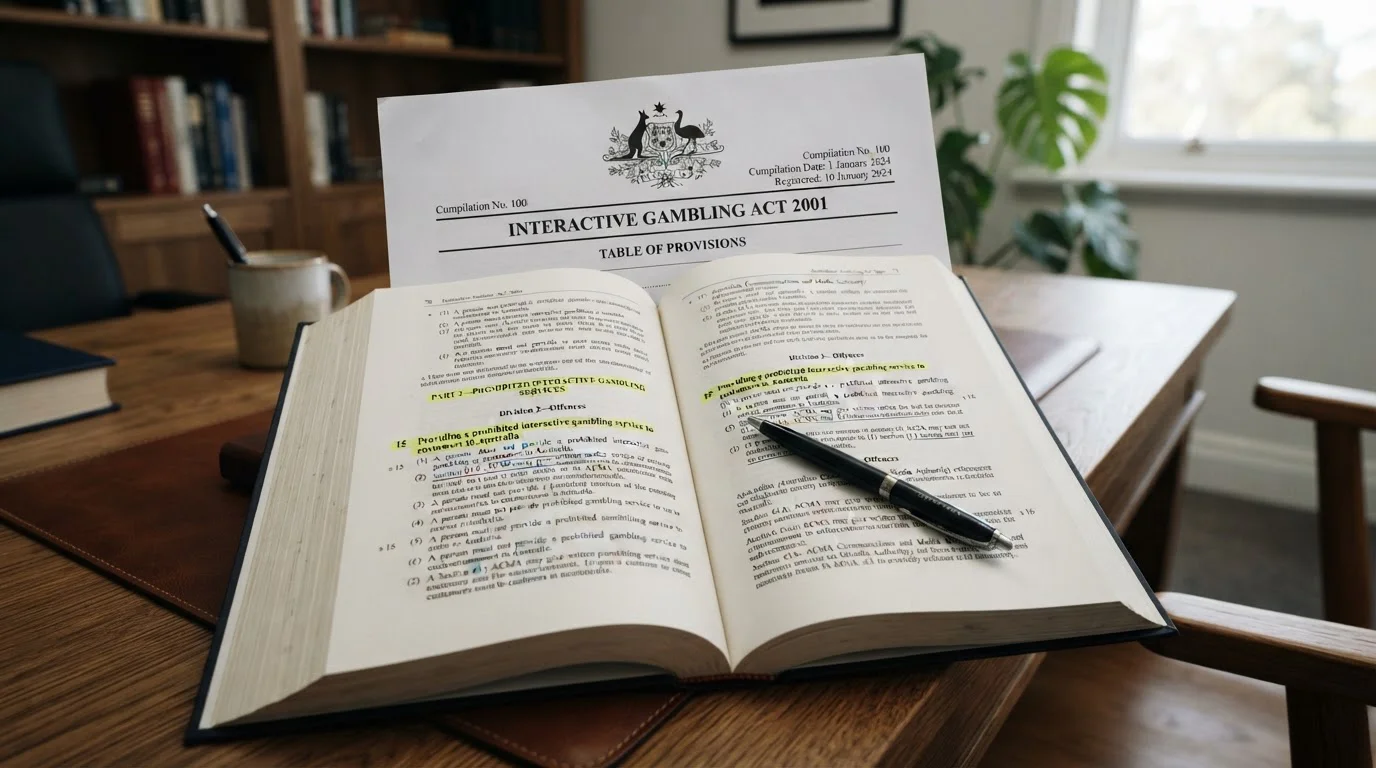
No Australian online casino exists. The Interactive Gambling Act 2001 killed that option before the market formed. Every offshore operator taking Australian deposits does so without local licensing, outside ACMA’s jurisdiction, and beyond the consumer protection frameworks that govern legal gambling in Australia. The regulator can block domains, disrupt payment flows, and expand enforcement — but it can’t license you a legal pokies site, because the law prohibits it.
No Australian-Licensed Online Casinos Exist
The IGA prohibits Australian-based operators from providing “interactive gambling services” — defined as online casino gaming (pokies, table games, live dealer), online poker, and in-play sports betting — to Australian residents. Sports betting operators hold licenses from state and territory regulators (NSW, VIC, NT), but those licenses exclude casino verticals. No state, territory, or Commonwealth regulator issues online casino licenses for Australian players.
That means every site on this list — RollXo, Spinsy, Hell Spin, BitStarz, all of them — operates unlicensed in Australia. Their Curaçao eGaming or Antillephone licenses have no legal standing here. The operator accepts your deposit, processes your bets, and pays your winnings entirely outside Australian regulatory oversight. If the site collapses, freezes your account, or refuses withdrawal, you have no recourse through ACMA, state gambling commissions, or Australian courts. You’re litigating in Curaçao under that jurisdiction’s consumer-protection laws, which are minimal.
What the IGA Actually Prohibits
The Act targets supply, not demand. Operating an online casino from Australia or offering interactive gambling services to Australians from an Australian base is criminal, carrying fines up to A$2.75 million per day for corporations. Playing at an offshore casino as an individual Australian resident is not illegal. ACMA has never prosecuted a player. Enforcement focuses on operators: domain blocking, payment disruption, advertising prohibitions.
Offshore operators hosting their servers in Curaçao, Malta, or other jurisdictions sit outside Australian law. The IGA can’t prosecute them, can’t seize their assets, can’t force compliance. What it can do: compel Australian ISPs to block access to unlicensed gambling domains (1,564+ domains blocked as of September 2026), direct Australian banks and payment processors to reject transactions with unlicensed operators, and prohibit unlicensed operators from advertising to Australians. Enforcement is infrastructure-level, not player-level.
The August 2026 Enforcement Expansion
The Interactive Gambling Amendment (Gambling Reform) Act 2026 (No. 72, 2026) registered on 28 August 2026, with new enforcement measures commencing 1 January 2027. The amendment strengthens ACMA’s domain-blocking powers, expands payment-disruption provisions to include cryptocurrency intermediaries and e-wallet providers, and tightens advertising prohibitions to cover affiliate marketing and social-media promotion of unlicensed operators.
Practically: ISP-level domain blocking will accelerate (current pace ~200–300 domains per year; expected to double post-2027). Payment processors (Visa, Mastercard, Australian banks) will face steeper penalties for facilitating unlicensed gambling transactions. Crypto on-ramps (exchanges selling BTC/ETH to Australian residents) may be compelled to block transfers to known gambling wallet addresses. The law is enforcement-mechanism expansion, not player-side criminalisation.
Are no minimum deposit casinos legal in Australia?
No offshore casino is licensed in Australia. The Interactive Gambling Act 2001 prohibits Australian-based operators from offering online casino services, and no state or territory regulator licenses online pokies, table games, or live dealer products. Every operator on this list holds a Curaçao license, operates outside Australian jurisdiction, and is unlicensed here. Playing at offshore casinos is not illegal for individuals, but the sites have no legal standing under Australian law.
Can I withdraw winnings if I only deposit the minimum amount?
Yes, but only after hitting the withdrawal minimum. If you deposit A$10 and the casino sets a A$50 withdrawal floor, you cannot cashout until your balance reaches A$50 — either by winning or depositing more. The deposit floor and withdrawal minimum are separate gates. Low-deposit players testing a site should rank operators by withdrawal minimum (N1 Bet A$25, Spinsy A$30) rather than deposit floor alone.
Withdrawal Minimums — The Hidden Barrier
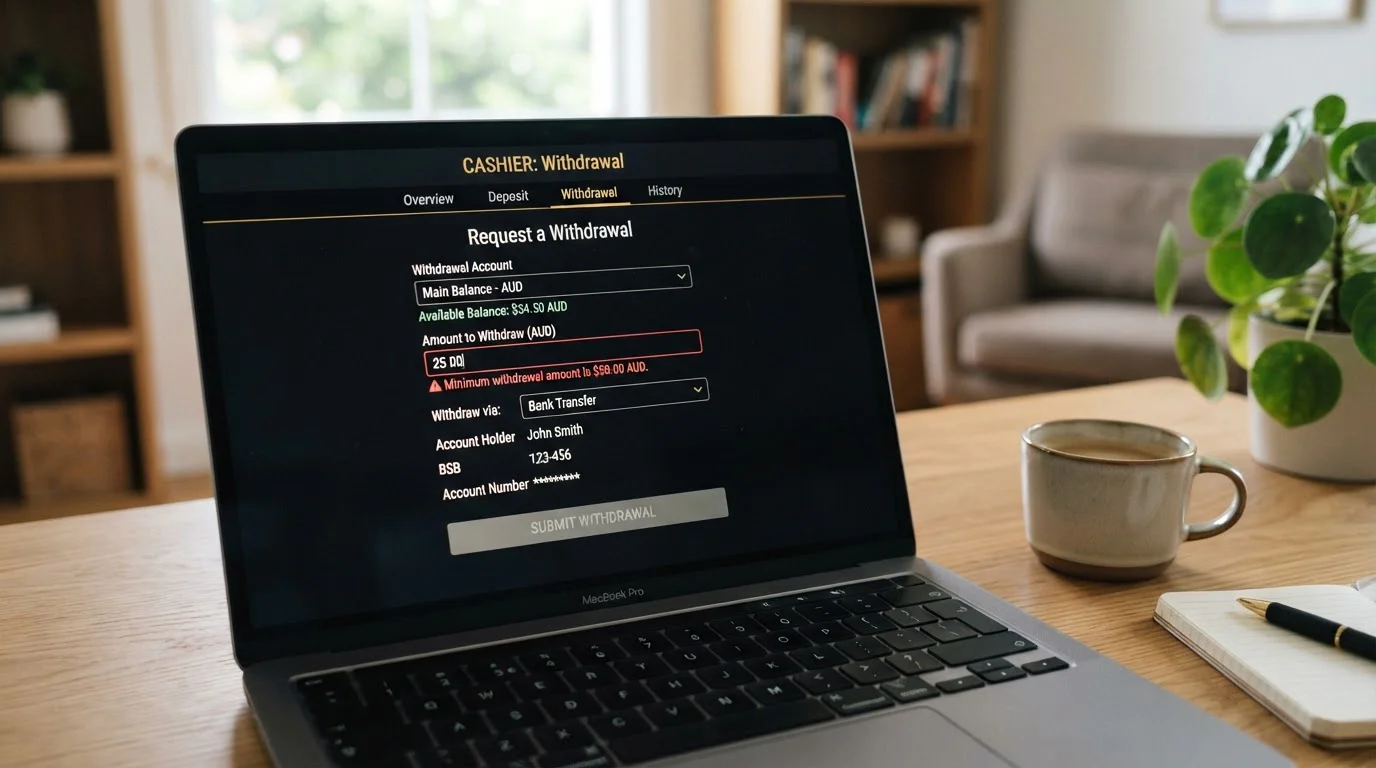
Deposit A$10, win A$40, request cashout — denied, minimum withdrawal A$50. Load another A$10, play to A$52, try again, wait 2 days for KYC approval, funds land. The A$10 deposit headline masked a A$20 entry cost. The withdrawal minimum is the gate that defines your real test expense, and most operators set it 2x–5x higher than the deposit floor.
Why the gap: deposit floors are public review-competitive (players compare them in reviews and rankings), withdrawal minimums live in cashier fine print. Operators compete on the visible number and extract cost on the hidden one. A A$10 deposit floor attracts clicks; a A$50 withdrawal minimum recovers compliance overhead (KYC processing, AML checks, payment-processor fees per transaction). The player optimising for lowest entry compares the wrong metric.
BitStarz, RollXo, Hell Spin, PlayMojo, Rooli — all set A$50 withdrawal minimums. 7Bit matches it. Kingmaker runs higher (€64 / ~A$100+). Two operators break the pattern: N1 Bet at A$25 and Spinsy at A$30. That A$25–A$30 range is the cheapest verification tier. If you’re testing a casino and want to minimise capital at risk, deposit A$15 at N1 Bet, play to A$26, cashout — you’ve verified the site pays for A$15 entry, not A$50.
The withdrawal minimum also interacts with payment-method selection. Crypto withdrawals often have lower floors (A$25–A$30 BTC equivalent) than fiat (A$50–A$100 for bank transfers). Some operators waive minimums on crypto-to-crypto loops (deposit BTC, withdraw BTC, skip KYC under A$2,000 aggregate) while enforcing stricter gates on Neosurf-to-bank-transfer cashouts. If you’re optimising for the lowest possible withdrawal test, crypto deposits with crypto withdrawals beat voucher-to-fiat routes.
Why do casinos advertise A$5 minimums when Neosurf vouchers start at A$10?
Because the A$5 claim markets well even when it’s unachievable. Neosurf vouchers are sold in A$10, A$20, A$50, A$100, A$250 denominations — no A$5 option exists at retail. Card processors set A$10–A$20 gambling-merchant minimums. PayID has no network floor, but casinos impose A$10–A$50 gates. A$5 deposits are structurally impossible on payment rails accessible to Australians in 2026. Operators advertising them either mean crypto (where network fees make A$5 deposits cost A$10+ in fees) or are marketing a figure the cashier won’t honour.
Responsible Gambling and Low-Deposit Risks
Low deposit floors lower the barrier to entry, which is the goal if you’re testing a new site. It’s also the goal if you’re chasing losses at 2 a.m. and your bank account has A$15 left. Offshore casinos don’t enforce Australian responsible-gambling frameworks — no BetStop register integration, no self-exclusion reciprocity between operators, no mandatory pre-commitment tools. A$10 minimums make impulse reloads frictionless.
If you’re using these sites, set your own gates. Deposit limits, session timers, loss caps — tools the casino may offer but won’t enforce. The A$10 deposit floor isn’t harm by itself; it’s the reload loop. Test the site once, decide if it’s worth using, set a deposit ceiling, walk when you hit it. The offshore market doesn’t care if you do, but the math says you should.
Gambling Help Online (1800 858 858) runs 24/7 for Australians. If the A$10 test deposit turns into A$200 reloads three nights a week, that’s the number. The offshore casino won’t stop you; the regulator can’t stop the offshore casino. You stop it or it doesn’t stop.
Minimum Deposit Casinos Australia 2026 — $1, $5, $10 Sites
Content created by the «Aussie Cashier» team